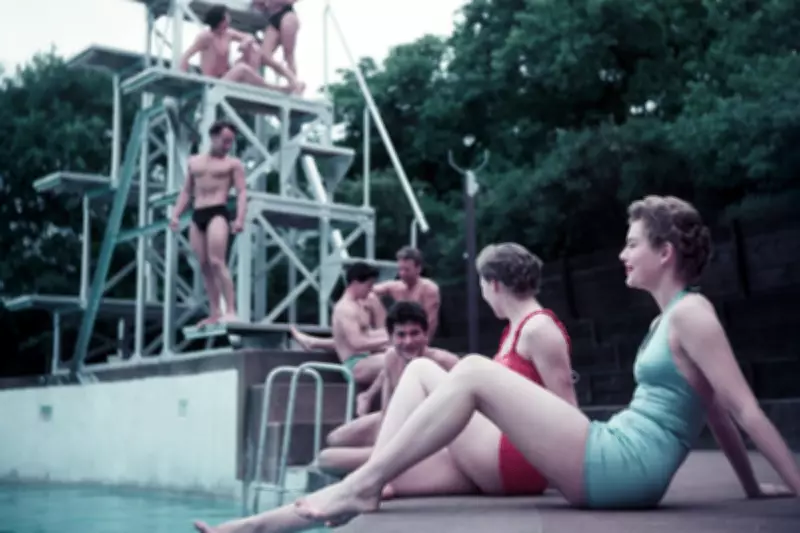
As temperatures soar, millions of us will flock to our local lido this weekend, but it is not all sunshine and soft breezes. After a chequered past, a dark cloud hangs over their future, too, writes Tom Fort.
I was not always a lido lover. My moment of truth came late in life, at Brockwell Park Lido in southeast London. It was a glorious September afternoon, and after a visit to the picture gallery in Dulwich, my wife, Helen, and I decided we needed a restorative swim. We did some lengths, and then I sat on the side in the sun and found myself feeling the pool as much as looking at it.
It was a curiously spiritual experience, like being in a great cathedral. I felt the specialness of the lido and the intense pleasure of the swimmers and sunbathers in being there. Their joyousness was palpable, in the water, in the air, in the surroundings. There was nowhere else anybody would rather have been on that late summer afternoon – including me. I became a lido convert.

In recent times, outdoor pools have taken to calling themselves lidos because, for marketing and branding purposes, it sounds more seductive than open air pool or corporation swimming baths. The first swimming facility to be known as a lido was on the Serpentine in London, still going strong. It is quite unlike any other because it forms part of a much larger body of water and is shared by the swimmers with ducks, geese, swans, and various species of fish. When it was opened in 1931, the newspapers took to calling it a lido, probably because it was a good word in a headline.
The first pool to be officially called a lido was the Guildford Lido, opened in 1935 by the mayor of the town. He declared that it was to be known as a lido because “it was more than just a swimming pool”; he then lay down his chain of office and removed his mayoral robes to reveal an old-fashioned swimming costume and dived in. “More than just a swimming pool” is imprecise but still useful. It means an area for sunbathing, maybe a lawn, maybe some trees to cast shade, a stylish cafe, perhaps fountains, cubicles with gaily painted doors to change clothes in. It must be a place to swim, obviously, but also somewhere that tempts you to linger. And, most importantly, it must be democratic, in the sense that it is open to all – which excludes those that are run as private clubs, including the very splendid Thames Lido in my hometown of Reading and its sister in Bristol.
When I was a boy, my brothers and I would cycle to an outdoor pool a few miles from our home. It was a concrete rectangle of chilly water so untreated with chemicals that in the frog breeding season, the edges were black with tadpoles. It had functional cubicles, a sweet shop, diving boards, a springboard, and a water chute. It was definitely not a lido.
Then there are pools that definitely are lidos but prefer for historic reasons to call themselves something else. One is the wonderful Jubilee Pool in Penzance, another the equally wonderful Stonehaven Open Air Pool on the east coast of Scotland, south of Aberdeen. The glorious Pells Pool in the Sussex town of Lewes is every inch a lido but is known to all as “Pells Pool”. All three should be on every lido lover’s list of places not to be missed.

The history of our lidos is, to put it mildly, chequered. The heyday for building them was the 1930s. Most were the work of local authorities – with the London County Council leading the way – although one or two owed their existence to private enterprise, most notably the incomparable Saltdean Lido near Brighton, opened in 1938. They were one response to a massive shift in public taste that came out of the 1914-18 war and gathered force over the two decades before the next conflict. There was a desire, particularly on the part of women, for a wider and deeper experience of life, to have more fun, to do different things. Women discarded the stays and corsets obligatory in Edwardian times. Hemlines rose, legs and arms were bared, hair was cut into bobs, and lipstick was applied in public. Mixed bathing became accepted on beaches and – in the teeth of opposition from some quarters – was adopted more gradually at outdoor swimming pools. Swimming costumes became less cumbersome and more pleasing to the eye. Exposing limbs to the sun was seen as healthy and natural. The demand for places to swim and sunbathe grew, particularly in towns and cities far inland.
The Labour-controlled London County Council promised to make the capital “a city of lidos” where no one would have to travel more than a mile or two to swim in a first-rate pool. Two of the first were at Kennington Park (1931) and London Fields (1932), and others followed, the last being Charlton Lido, opened in 1938. The outbreak of war a year later put an end to the programme. By then many other towns and cities had taken up the cause of open-air swimming and also built pools that were both a boon to healthy living and a source of local pride.
For a few years post-1945, Britain’s lidos boomed. Whenever the sun shone, they were packed. But insidious influences were at work to undermine them. One was our notoriously fickle weather – hot summers were few and far between in the 1950s and 60s, and heatwaves did not last long. Package holidays to Spain and other Mediterranean destinations, with a guaranteed suntan at the end of it, made our lidos look out of fashion. Constructed from reinforced concrete, they deteriorated badly, and the more cash-strapped local authorities put off necessary repairs and refurbishment, the quicker they went downhill.
Throughout the 1960s, 1970s, and 1980s, lidos all over the country were closed and either demolished or left to rot, without much more than a murmur of protest. In 1991 the Thirties Society (which shortly afterwards became the 20th Century Society) produced a booklet entitled “Farewell My Lido”, an eloquent lament for the loss of so many of these irreplaceable assets. Only one, Saltdean Lido, had been given grade 2 listing; and it was decayed and visibly struggling.
With hindsight it is possible to see that the tide turned around then. Over the next decade several more lidos were given grade 2 listing. Councils discovered that they could no longer condemn these neglected treasures without facing a public outcry. Funding for essential restoration became available, mainly from the National Lottery. And tastes were changing. In 1999 Roger Deakin’s book Waterlog featured a hymn of praise to the joys of outdoor swimming, in rivers, lakes, moats, and the sea. Deakin tended to adopt a lofty and disapproving view of swimming pools, but he had a soft spot for the old lidos, writing that “they are to swimming pools as lingerie is to underwear”, and likening doing lengths at Parliament Hill Lido to being “in a state of grace”.
One by one, lidos emerged from lengthy and colossally expensive makeovers as the gleaming and superb temples of pleasure they had been when first built. Attendances rose steadily. Then came Covid. Initially, the pandemic seemed like a hammer blow. But as the summer of 2020 progressed and restrictions eased, swimmers flocked to lidos as never before. The lido provided not just exercise, but an escape from a dark and unsettling world. They provided healing and the vital sense of community from being with like-minded souls.
Our lidos have not looked back, helped by our warmer summers. The surge in the popularity of cold water swimming in winter has given some of them a significant extra dimension as well as a new income stream. Last year saw bumper takings, with many of them recording their greatest number of customers ever. But let us not get carried away. They are costly to run, and when something structural goes wrong – as it inevitably does, sooner or later – they are hugely expensive to put right. Quite a number of towns have declared an interest in providing a lido, without fully realising how to pay for it. Talk of the Golden Age of Lidos is distinctly premature.
But we have slowly become a nation of outdoor swimmers. Indoor pools will always have their place, but does anyone love a modern leisure pool? Lidos inspire affection that spills into devotion, and for many life without going to the lido is unthinkable. They are wonderful assets, and it is a matter for rejoicing that we have learned to value them properly.