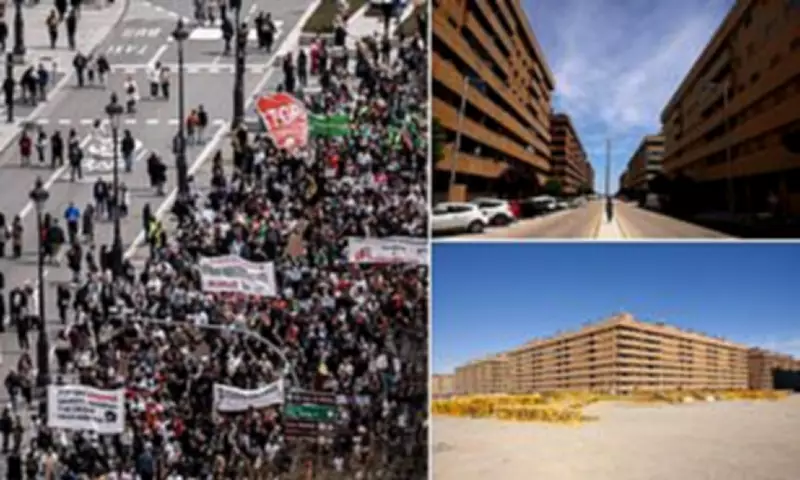
More than 100,000 half-finished homes currently lie empty in Spain, after locals spent years complaining that they had nowhere to live. Data from Spain's Ministry of Housing indicates that this vast array of unfinished homes is only a portion of those in the country. The government's report into the issue only tracked developments that were meant to host at least 1,000 homes and had building levels of less than 70%.
On top of this, there is enough developed land with streetlights and roads - but no homes - in Spain for 390,000 homes. Many of these developments exist in an eerie state of limbo as a result of the 2008 financial crisis, with many housebuilders defaulting on loans and declaring bankruptcy, unable to pay their loans back. And since then, the country's property development market has come to something of a standstill.
Shortage and Surging Demand
The Bank of Spain estimates that there is currently a shortage of almost 700,000 homes. Because of this, demand for homes has surged, and Spanish residents have increasingly felt priced out of their communities. In the last few years, they have taken out much of their anger on tourists and non-residents who buy up homes in holiday hotspots. Riots and protests have blighted many of Spain's biggest tourist cities, including Madrid, Barcelona, Malaga and Mallorca's Palma.

In many parts of the country, legislation about banning Britons from buying property is being debated. On top of this, EU laws already require special visas and residency permits to let Britons stay in countries like Spain, increasing the difficulties and costs for UK residents to own homes in the country.
Expert Opinion on the Crisis
Economist and real estate expert Ignacio Ezquiaga told El Pais that the country is in a deep crisis that could have been avoided following 2008. He said: 'There was a first step during the 2008 crisis, when the government bailed out banks and financial institutions to prevent their collapse; now another important step must be taken: putting all that developed land to work.'
'There is land for 390,000 homes that are developed but vacant, and almost 100,000 homes that are half-built. It's a vast pool of land sitting idle. In cases like Buniel, and many others, forced expropriation should be carried out to reverse the situation.'
Protests and Legislative Actions
Spaniards have become desperate for new properties in recent years, and have begun lashing out at anyone from outside the country trying to establish a life there. Earlier this year, radical new plans drawn up in the Balearic Islands were feared to shut the door on Britain's second-home owners. Lawmakers in Mallorca, Menorca, and Ibiza are working on a law that would block non-residents from buying property if they have not lived on the island for at least five years.
The bill, tabled by Left-wing party Mes per Mallorca, comes amid mounting fury over soaring house prices and the relentless march of tourism. Around 90,000 homes across the Balearics are already owned by foreign nationals - some 16 per cent of the housing stock. British buyers remain a powerful force in the Spanish property market, with nearly 12,000 homes snapped up by UK purchasers in 2024 alone, according to Idealista.
Foreign buyers accounted for 13.8 per cent of all sales last year - almost 97,300 transactions, a record high for non-Spaniards. Lluis Apesteguia, an MP for Mes per Mallorca, insisted that 'extraordinary measures were necessary' after the islands welcomed 19 million visitors last year. He said: 'We have to prioritise the houses that are for living in – not for those who want to speculate and continue with this game of Monopoly.'
Opposing Views and Calls for Change
But others don't see foreigners owning property in Spain as a problem, and officials are calling for the European Union to axe its 90-day travel limit for Britons. Former Spanish tourism ministers Fernando Valdés and Hector Gomez have argued that the post-Brexit rule severely harms the Spanish economy and are pushing for it to be changed.
Currently, non-resident Britons in Spain can only spend 180 days a year in the country, in two batches of 90 days. To stay longer, Brits must rely on traditional long-stay visas or residency permits - but officials are now lobbying for EU-wide exceptions to allow tourists to remain for up to 180 days at a time.

'I think that it would be great for everyone,' said Sean Woolley, co-author of 'Home Truths: A candid analysis of the Costa del Sol Property Market', adding that Spain has historically benefitted enormously from British tourism. 'I think that Spain has realised that second home tourists actually contribute disproportionately more money than someone staying in a hotel for the weekend,' he told the Daily Mail.
'They treat it as a home. They go shopping, they use services, restaurants, tradespeople, cleaners, gardeners, interior companies, and legal firms. Second home owners tend to be more wealthy - they have higher disposable income, and they contribute more to the local economy than just passing visitors would. That's what has piqued the interest of the Spanish,' he said, with politicians now thinking: 'OK, how can we retain these high-quality visitors?'