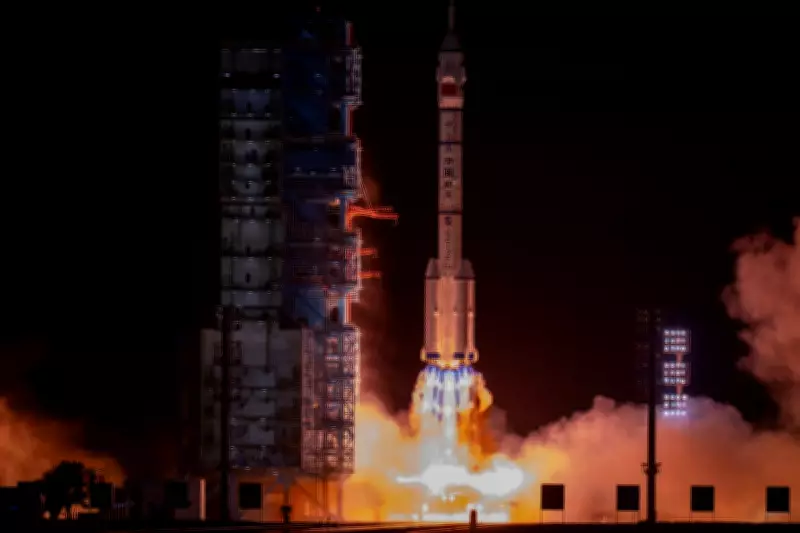
China has successfully launched the Shenzhou 23 spacecraft, carrying three astronauts towards its Tiangong space station. The mission, which took off from the Jiuquan Satellite Launch Center in northwestern China on Sunday evening, marks another significant step in Beijing's ambitious space programme, which includes a planned crewed lunar landing by 2030.
Crew and Milestones
The crew consists of commander Zhu Yangzhu, Zhang Zhiyuan, and Lai Ka-ying, also known by her Mandarin transliteration Li Jiaying. Ms Lai, a Hong Kong native with a doctorate in computer forensics, becomes the first astronaut from the city to participate in a space mission, representing a historic milestone for the region.
Scientific Objectives
During their stay aboard the Tiangong station, the astronauts are scheduled to conduct dozens of scientific and application projects. They will also perform an in-orbit rotation with the Shenzhou 21 crew, who have been stationed there for over 200 days. One astronaut is designated for a year-long mission to study human adaptability and performance limits in extended spaceflight, which is crucial for future long-duration missions.

China's Space Ambitions
This launch is part of China's rapidly expanding space programme, which has included multiple missions to Tiangong since its first crewed visit in 2021. The station was developed after China was effectively excluded from the International Space Station due to US national security concerns, leading to a growing rivalry with NASA, which aims for a lunar landing in 2028.
Shenzhou Programme History
The Shenzhou programme, meaning "Divine Vessel," previously made headlines last year for an emergency mission that successfully rescued a team of astronauts stranded on the space station following spacecraft damage. This current mission further solidifies China's position as a major player in global space exploration.
The spacecraft blasted off from the Jiuquan Satellite Launch Center in northwestern China. The much-anticipated launch comes as China prepares for its first crewed lunar landing by 2030.