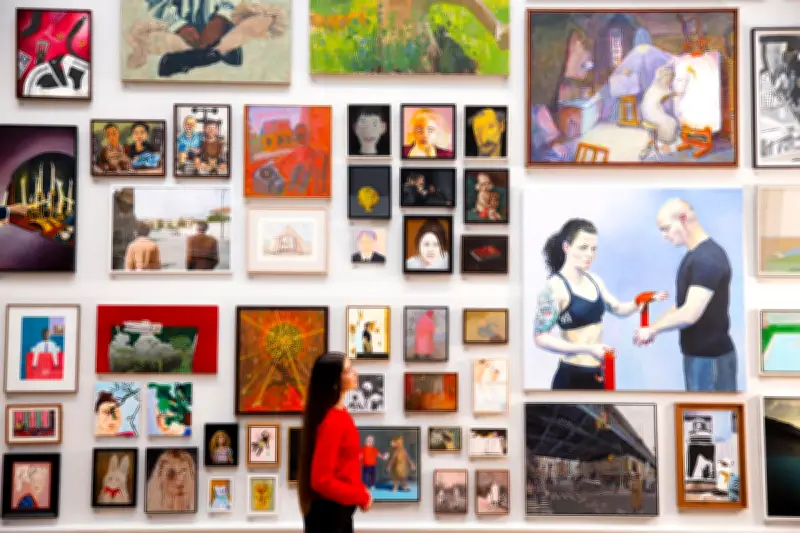
The Royal Academy Summer Exhibition 2026, themed 'Interconnectedness,' falls short of its promise. Coordinator Ryan Gander claimed each artwork would relate to its neighbors, but the reality is a chaotic mix of disparate pieces.
Disconnected Displays
At the press view, Gander's assertion was immediately contradicted. A wall featured Isaac Julien's waxed inkjet print flanked by a colorful metal rail and an abstract black-and-pink piece, sharing no apparent connection. Nearby, Frank Bowling's rich color study stood alone. The theme seems a convenient label for the unmanageable 1,851 works, blending the portentous and trivial.
Gander's own contribution—mirrors half-covered in sheets—offers little drama. His 'line of passivity' at the two-meter mark, once hat height for gentlemen, suggests placing small artworks high, requiring binoculars, rather than at eye level.

Nature and Gardens: A Fleeting Theme
Initially, the show appeared to focus on nature and gardens. Katherine Jones's room featured charming flower pictures, botanical studies, and a quilted cabbage, with a slogan 'Gardens are the New Galleries.' However, this coherence quickly fades. The pile of golden bean pods resembles gilded turds.
Figurative art is prominent, but many works feel outdated. A white ovoid sculpture channels Barbara Hepworth, and a plain red canvas echoes early 20th-century monochrome. Familiar names appear: Quentin Blake's melancholic blue heads, Tracey Emin's forceful forms, and Anselm Kiefer's anguished figures. A political message is implied.
Animals and Clutter
Animals dominate: 27 cat studies and half a dozen frogs outnumber religious works. Small-scale, twee pieces resemble gift shop items. Sculpture suffers, with a flat tire as a low point. Antony Gormley's cardboard box pile was mistaken for trash. Notable exceptions include John Maine's granite piece, David Noonan's bronze owl, and Kevin Francis Gray's monumental Hades Head.
The sheer volume overwhelms striking pieces. Reducing the count to 1,000 would enhance coherence. The exhibition runs from June 16 to August 23 at the Royal Academy.