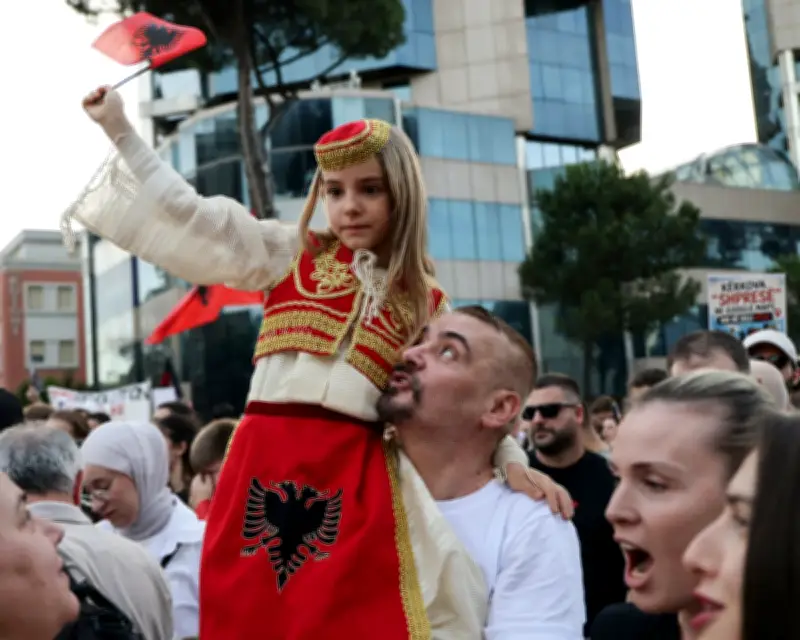
In Tirana on 6 June 2026, protesters gathered to oppose a proposed luxury resort by Jared Kushner on an Albanian island. The image of the protest, captured by Vlasov Sulaj, shows a nation united against what they see as a sell-out of their natural heritage. The slogan 'Albania is not for sale' echoes through the streets, reflecting a deep-seated respect for the country's environment and sovereignty.
The Backdrop of the Protests
The controversy began when Ivanka Trump described discovering the island during a barefoot hike, captivated by its beauty. Years later, her husband Jared Kushner sought to develop it into luxury real estate, despite it being a protected wildlife zone. The Albanian government, led by Prime Minister Edi Rama, has shown enthusiasm for the project, though no final deal has been signed. This enthusiasm stems from Albania's economic struggles: after decades of transition from communism, the country has lost over 1.2 million citizens to migration, suffers from low manufacturing, an outdated agricultural sector, and a crisis in higher education following privatization in the 1990s.
Economic Pressures and Environmental Costs
Albania's only remaining asset on the global market is its nature. While sustainable development is ideal, it is expensive. Real estate and luxury tourism offer faster growth, but at the cost of increased inequality and environmental degradation. These models, once adopted by richer countries, are now regretted. Albanians understand that speculation without state support makes housing unaffordable, and luxury tourism turns local holidays into a privilege for the few. With weak unions and exploitative labor conditions, many Albanians choose to emigrate, facing xenophobia abroad.

Political Disenchantment and Civic Awakening
In May 2025, the ruling Socialist party won a fourth term with a historically low turnout of 44%, despite extending voting rights to the diaspora. The election lacked a manifesto or principled debate, with the opposition leader often portrayed as an owl on social media. The government's only promise was EU accession by 2030, a tactic that conflates criticism of the government with opposition to Europe. This has led to a political landscape where corruption is blamed for systemic issues, rather than addressing the rules themselves.
Now, young Albanians are pushing back. The protests escalated after a new law on strategic investments, which critics say entrenches oligarchic control. The tipping point came when heavy machinery entered a protected coastal wetland, and a viral video showed private security guards beating a protester while police stood by. A generation that once accepted fatalism now questions whether democracy must be rule by the super-rich.
A New Kind of Mobilization
This movement is inspiring, reminiscent of the fall of communism. Unlike previous opposition efforts that involved violence, these protests are peaceful: protesters sing, dance, clean up after demonstrations, and hand flowers to police. They are not giving up on the state but insisting it belongs to them. The slogan 'Albania is not for sale' reflects self-respect, a quality the government has forgotten. In a Europe where postcommunist disenfranchisement often fuels xenophobia, Albania offers an alternative: a leaderless movement that is harder to co-opt but also fragile. To succeed, it must move from resistance to proposition, finding political unity beyond a single cause.
A Lesson for Europe
As long as democratic politics is captured by the wealthy, protests may only give the illusion of change. The challenge is to build a new system, not just replace individuals. For once, Albania doesn't need to catch up with Europe; it can lead. A generation willing to mobilize for an alternative model—rejecting oligarchic capture and linking environmental protection to democratic legitimacy—should be celebrated. Instead of becoming 'like the rest of Europe,' Albania could teach the old continent a lesson in self-respect.