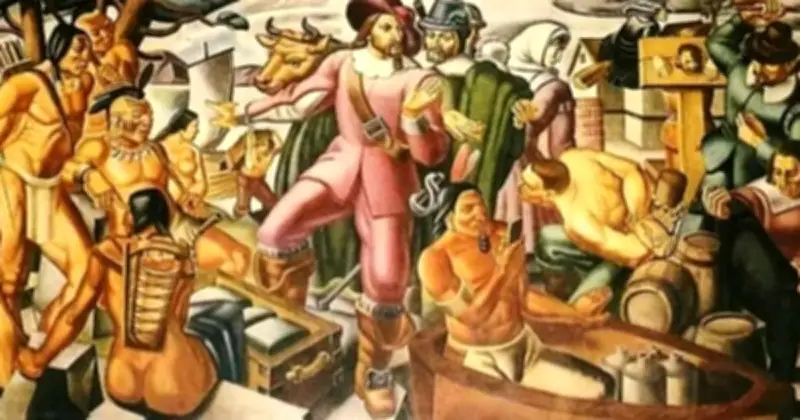
A mysterious painting from 1937 has sparked debates about time travel after a Native American man appears to be holding what looks like a modern smartphone. The artwork, titled Mr Pynchon and the Settling of Springfield, was created by Italian painter Umberto Romano and depicts the arrival of settlers to Springfield in the 1620s.
In the painting, a local figure holds a small black rectangular object, gazing at it as if taking a selfie. Many viewers have pointed out the striking resemblance to an iPhone, which was not invented until 2007. This has led conspiracy theorists to claim the painting is proof of time travel.
Alternative Explanations
However, experts offer a more mundane explanation. Brian Anderson, writing in Motherboard, suggested the object is likely a mirror. He noted that mirrors were commonly traded between European settlers and Native Americans. The way the man holds it up, as if examining his reflection, supports this theory.

This is not the first time a supposed 'mobile phone' has appeared in historical artwork. In 1928, a Charlie Chaplin film, The Circus, showed a woman in the background holding an unidentified object to her ear, which some believed was a mobile phone. Irish filmmaker George Clarke highlighted this in a 2010 YouTube video, which has nearly seven million views.
Debunking the Theories
Critics have dismissed these claims. In the Chaplin film, some argued the woman was shielding her eyes or cupping her ear. The Daily News suggested she was using a hearing aid. Similarly, the painting's object is more plausibly a mirror than a time-traveling device.
While the idea of time travel captured in art is intriguing, historical context and expert analysis provide rational explanations. The painting remains a fascinating piece, but not evidence of time travel.