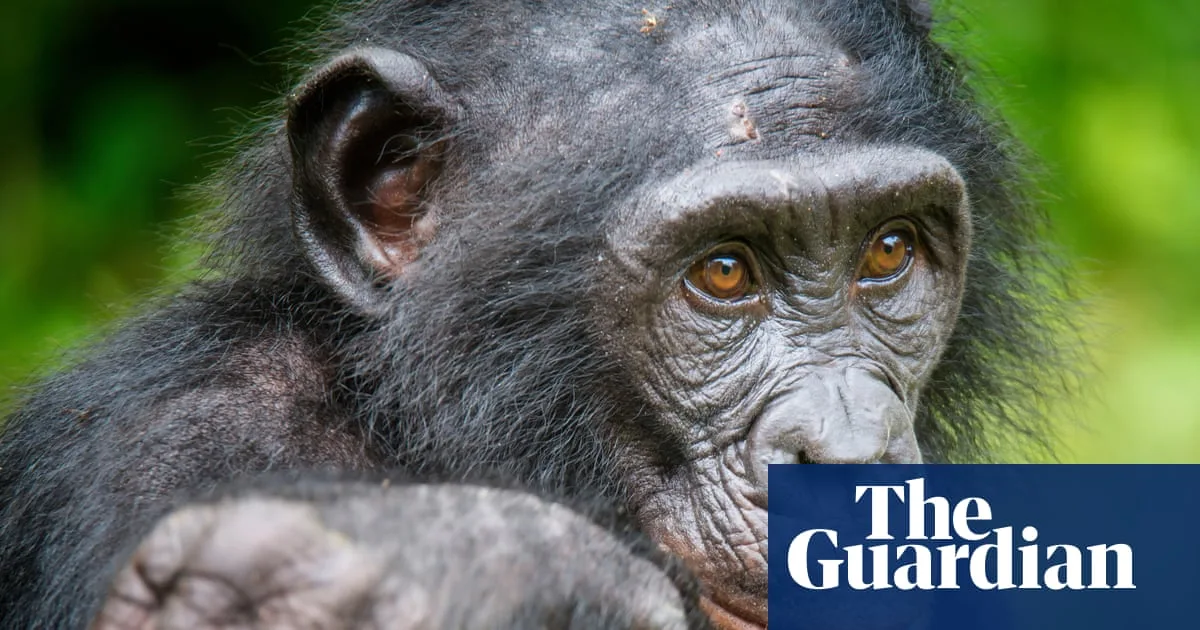
Researchers have found that bonobos can engage in make-believe play, a cognitive ability previously thought to be unique to humans. The study, published in the journal Science, involved a bonobo named Kanzi who was able to identify the location of imaginary objects in pretend scenarios.
Kanzi, who has since died at the age of 44, was first trained to point to containers filled with juice. In subsequent experiments, researchers pretended to fill empty cups with an empty jug and asked Kanzi to indicate which cup contained pretend juice. Kanzi selected the correct cup in 34 of 50 trials, a result significantly better than chance.
The researchers also tested whether Kanzi could distinguish between real and imaginary liquids. When presented with one cup containing real juice and an empty cup that was pretended to be filled, Kanzi chose the real juice in 14 out of 18 trials. In a third experiment, Kanzi correctly identified the location of an imaginary grape placed in one of two transparent containers.

Dr Amalia Bastos of the University of St Andrews, the study's first author, said the findings show that animals can understand pretence in a controlled experimental setting, which had not been demonstrated before. The ability to make believe may date back to the common ancestor of humans and bonobos, between six and nine million years ago.
The researchers noted that Kanzi was not rewarded for correct answers, indicating he was not simply learning a desired response. Prof Zanna Clay of Durham University, who was not involved in the study, said the findings provide rigorous experimental evidence that apes have a form of imaginative thinking, and that it would be more surprising if such abilities were found in more distantly related species.