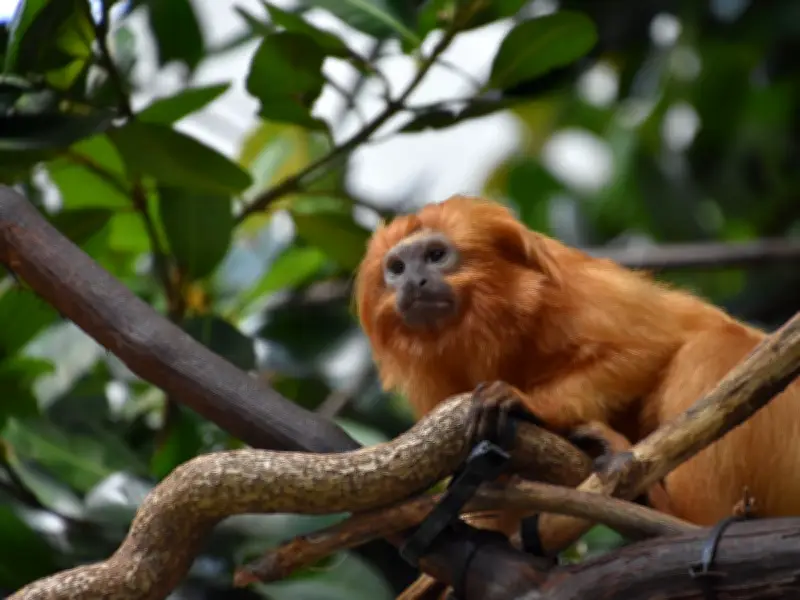
Wild monkeys in the Amazon have been found carrying a deadly human disease for the first time - a startling discovery scientists say is likely fuelled by civilisation pushing deeper into the rainforest.
The Discovery
A joint team from the University of Salford in the UK and Brazil's Federal University of Amazonas found human hepatitis B in blood and liver samples from 88 'new world' primates, spanning 28 species. The findings show evidence of human-to-monkey transmission in areas most impacted by deforestation and urban sprawl.
In Brazil's Rondonia and Mato Grosso states - regions where forest has been heavily cleared, and towns sit tight to the treeline - 17 of 49 monkeys tested positive for hepatitis B virus (HBV), with the genetic fingerprints matching the strains circulating among local people. However, in a remote patch of the upper Japurá River, deep in Amazonas state, none of the 39 monkeys sampled tested positive for infection, reports Refractor.

The contrast, researchers say, is a red flag: the closer humans come to wildlife, the more likely we are to swap diseases - with consequences neither side is ready for.
Understanding Hepatitis B
HBV attacks the liver and can cause cirrhosis and cancer in people. It typically spreads through blood and certain other body fluids, not casual contact - which makes the leap into wild primates all the more puzzling.
The study, published in the journal EcoHealth, is the first of its kind to document HBV in New World primates, found in Central and South America, raising urgent questions about how it got there and what happens next.
How could a human virus jump into the jungle?
Lead researcher Professor Jean Boubli, of the University of Salford, said the route of transmission is still a mystery. “As yet, it is very hard to ascertain,” he said, noting that human-to-human spread is usually limited to blood or specific body fluids.
One plausible pathway is the region's thriving pet trade: infant and juvenile monkeys are sometimes kept as pets, potentially exposed to infection, and then released or abandoned once they grow up and become harder to handle. Another factor is geography - city centres and settlements now press up against forest edges, creating constant points of contact that simply didn't exist at this scale in the past.
Deforestation, Boubli warns, is the "number one threat". As trees fall and roads slice through once-intact habitats, people, livestock and wildlife are funnelled into the same spaces, multiplying the chances of cross-species spillover. The team says halting deforestation and setting up buffer zones between towns and native forests would help reduce risky encounters — and give both animals and people a fighting chance to stay healthy.
A new pandemic? What it means for the monkeys – and for people
Right now, nobody knows if the infected monkeys are sick. The animals don't show obvious clinical signs in the wild, but given how serious HBV can be for humans and apes, scientists fear there could be hidden harm. The study calls for careful, ethical follow-up in captivity to learn whether HBV causes illness in New World primates, how severe it might be, and whether it lowers survival rates when animals return to the wild.
Proving monkey-to-monkey transmission, however, will be much tougher, both ethically and practically, especially if the needed conditions can't be safely or realistically replicated.
There's also a wider public health concern. Across the Amazon, Indigenous peoples and local communities are estimated to consume around three million primates for subsistence. For thousands of years, those populations were small and relatively isolated, with minimal disturbance to the forest. Today, the picture is different: millions of newcomers, expanding towns, and a constant flow of people and goods are bringing new microbes into the region - and potentially creating fresh routes for pathogens to move between species.
That doesn't mean a new pandemic is looming, but it is a clear signal that human behaviour is reshaping disease risks in the world's largest rainforest.