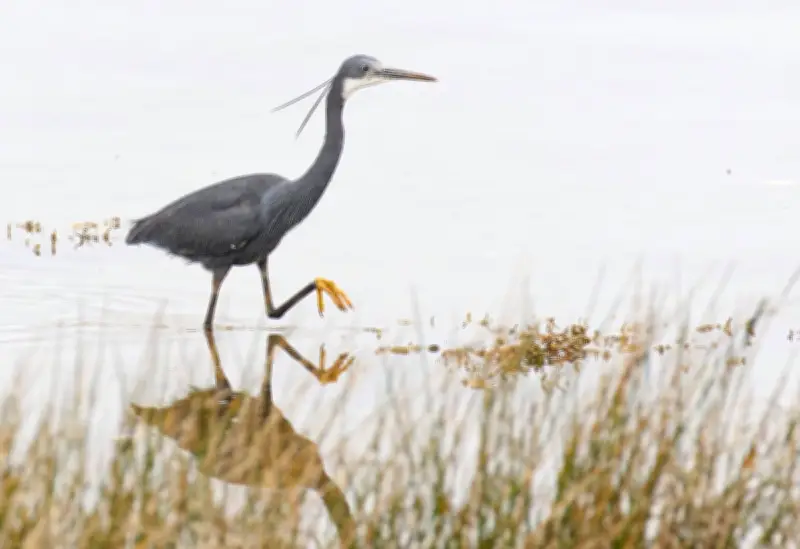
Hundreds of birdwatchers have gathered in north Wales to see a western reef heron, a tropical bird usually found between west Africa and India. This marks the first confirmed sighting of the species in the UK.
First Sighting in Foryd Bay
The heron was initially spotted in Foryd Bay over the weekend before moving to Caernarfon harbour, where it fed among boats. The sighting has excited birdwatchers nationwide and prompted experts to highlight the role of climate change in altering bird ranges.
Climate Change Enables Survival
Nick Moran, training manager at the British Trust for Ornithology (BTO), said: "The fact that they are getting here and surviving is likely due to increasingly mild winters. It's much easier to survive winter now than 50 years ago because shallow water bodies rarely freeze over."

Another rare tropical bird, the squacco heron, typically found in southern Europe and north Africa, has also attracted birdwatchers to Lincolnshire this week. The BTO noted this species is seen in the UK only a few times a year.
Broader Trend of Northward Shifts
Alexander Lees, reader in biodiversity at Manchester Metropolitan University and chair of the British Ornithologists' Union records committee, said these herons are part of a pattern: "We are seeing a shift and readjustment for biodiversity. Last year, we had the first breeding record of the zitting cisticola, a Mediterranean warbler that moved north with climate change."
Other notable tropical sightings in recent years include the black-winged kite (first in 2023, seen in Norfolk this year), the brown booby (2019), and the white-rumped swift (first in Britain in 2018). In 2022, the RSPB said European bee-eater sightings were an "unmissable sign" of the nature and climate emergency.
Identification and Excitement
Simon Hugheston-Roberts, who first spotted the bird in Wales, told the BBC he was on a walk and "was lucky to see a small dark heron flying over me on the shore." He applied his experience birdwatching in Africa and the Middle East to identify the species.
Ian Lycett, who travelled from London to see the bird, told BirdGuides: "That I would be watching a stunning new species for Britain, with Caernarfon Castle as a backdrop, was not what I expected. It was a long drive but well worth it."
Distinctive Appearance and Future Sightings
The western reef heron resembles the common little egret in size but has distinctive blue-grey plumage. Moran said: "They're very striking, unlike anything else we have here." The bird is an adult and likely arrived from Europe, possibly hatched there. Moran cautioned against expecting a sudden influx but added: "I strongly suspect we'll get more sightings."