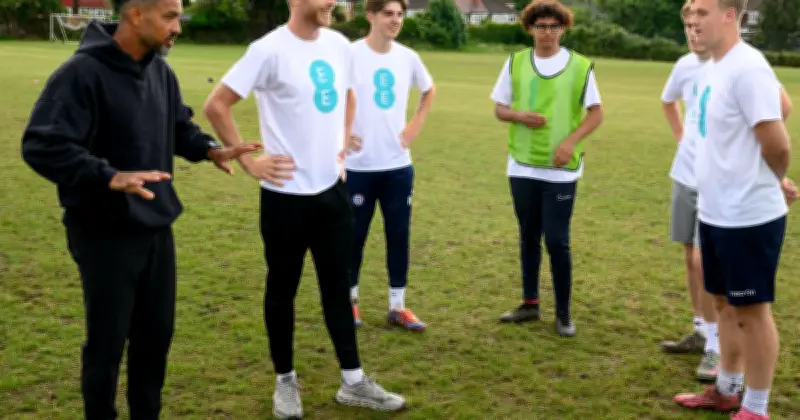
A youth football coach has warned that boys are arriving at training anxious and lacking confidence after being exposed to harmful social media content. Josh Paul, founder of Fit 4 Football, says his role has shifted dramatically, with children increasingly turning to him for support with mental health struggles fueled by online influences.
The Changing Role of Youth Coaches
Josh Paul, 35, from London, explained that he now spends much of his time as a mentor first and a football coach second. “In the last five years, I've been showing up to my sessions as a mentor first, and then a football coach second,” he said. “When I first started coaching, a child might turn up upset because they'd fallen out with a friend at school. Now I've got children that don't want to come into training because they've seen something online that has scared them, upset them, or told them they're not good enough.”
His experience aligns with new research commissioned by EE, which found that 42% of boys aged 11 to 16 regularly encounter content telling them to “man up” or hide their emotions. Furthermore, 71% of boys say they feel overwhelmed by pressures they face online. The study also revealed that football is becoming one of the few spaces where boys feel comfortable opening up, with 78% of coaches reporting that a child has confided in them about personal issues unrelated to football, and 95% saying supporting emotional wellbeing has become an increasing part of their role.

Mentorship Over Coaching
Josh emphasized the importance of listening and providing reassurance. “The biggest thing I tell children is, ‘You'll be fine. You'll be alright.’ Sometimes that's exactly what they need to hear,” he said. He noted that when he was 13, he would have been influenced by online figures promoting unrealistic standards. Now, he helps young players navigate these pressures.
Former England footballer Theo Walcott, a father of two young boys, supported the initiative. “Growing up in football, I saw how powerful the environment can be in building confidence and character. Now, as a dad, I’m even more aware of the pressures boys face, especially online. Football gives boys a space to express themselves, build resilience, and learn from positive role models,” he said.
EE's Yes Boys Campaign and Mentor Badge
EE has launched the Yes Boys campaign ahead of this summer’s tournament in the USA, Canada, and Mexico, which kicks off on 11 June. The campaign celebrates football communities as a positive tool against harmful online influences. EE’s new Mentor Badge initiative equips parents, coaches, and young people with skills to navigate online pressures.
Research by EE showed that 71% of parents whose sons play sport believe a football coach has as much or more influence on their son's understanding of masculinity than the internet. Only 14% said online content had a greater impact than a coach.
Expert Insights
Professor Ben Hine, Professor of Applied Psychology at the University of West London, said the findings reflect a wider social shift. “Football may now be one of the few trusted spaces where boys feel emotionally safe. Sport creates a sense of belonging and community that allows boys to open up in ways they might not elsewhere. The fact that so many boys are speaking to coaches shows they are yearning for positive male role models. The challenge is making sure those role models are there,” he said.
Both Josh and Professor Hine stressed that volunteers should not be discouraged from getting involved. Josh said, “As a coach, you just need to listen and be someone that young people know they can talk to. I'm going to help children not make some of the mistakes that I made.” Professor Hine added, “You don't need to be a registered therapist to change a child's life. Most of the time it's about providing a safe space, listening without judgement, and helping young people feel they belong. As the online world has become stronger, we need to make the offline world stronger too. Thank goodness Josh went into coaching because voices like his are so important.”