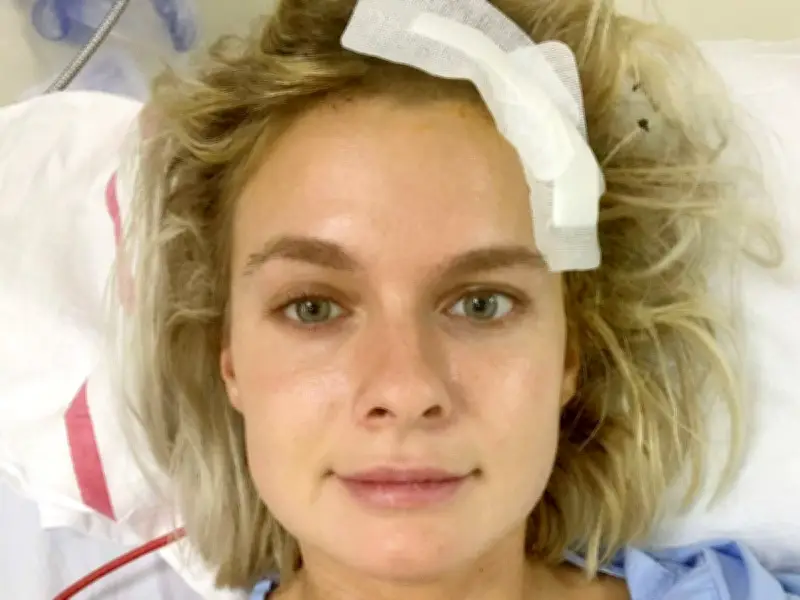
A British woman who collapsed suddenly at work saw her life come to a shuddering halt with no warning signs. Mez Olivia, 30, from Lampeter, Wales, had no symptoms before collapsing at work and waking days later in intensive care.
She was left with no feeling on the right side of her body and spent six months recovering in the UK, having to relearn to walk. The social media manager, who is still undergoing radiotherapy, said: "One minute I was laughing with everyone and the next I screamed and collapsed. I had breakfast as normal that morning. There were no signs anything was wrong. My memory just stops."
Collapse at Work in Dubai
Her colleagues in Dubai rushed to her aid after she lost consciousness on 16 November 2021. She said: "My co-worker caught my head and my manager put me in the recovery position and called an ambulance. It looked like I had died, so everyone was in complete shock."

Doctors found that Mez had suffered a brain haemorrhage caused by an arteriovenous malformation (AVM) — an abnormal tangle of blood vessels in the brain. She spent 11 days in intensive care and received emergency treatment after doctors warned her family that she would not survive without intervention.
Life-or-Death Surgery Decision
Due to Covid restrictions, her sister was unable to travel to Dubai to give consent for surgery after testing positive. Her father and brother faced the agonising decision to go in her place. Mez said: "They were told it was life or death. If I didn't have the operation, I would die, but I needed written consent to go through with it."
Medics performed an embolization procedure, guiding instruments through an artery in her groin to seal off the abnormal blood vessels responsible for the bleed. Large portions of her hospital stay remain a complete blur. She said: "It's two weeks of my life that I will never get back because I can't remember it. I had a drain in my brain and I don't think I realised how ill I was. I remember my sister telling me to be careful not to hurt my right side when I was lying down and I said, 'I don't have a right side.' I couldn't feel it."
Return to UK and Rehabilitation
After her condition stabilised in Dubai, Mez was flown back to Britain in December 2021 as her insurance cover was running out. She spent Christmas Day alone in hospital isolation before being transferred from Heathrow directly to Glangwili Hospital in Carmarthen, where she commenced her rehabilitation. Mez said: "My dad had to pay for a taxi from Heathrow, London where I landed, all the way to west Wales. Every day was the same. I had hydrotherapy, physiotherapy and had to learn how to walk again."
Placed on a stroke ward alongside elderly patients, Mez described the experience as a real eye-opener. She said: "I didn't realise how serious strokes were because I'd always associated them with older people. They gave me a side room, but sometimes I'd have to come out because someone had died. It really showed me how devastating strokes can be."
Determined to Walk Again
When she was discharged from hospital, Mez was informed she might never walk independently again and was advised to use a wheelchair. Determined to prove medics wrong, she committed herself fully to rehabilitation. She said: "I asked my consultant if I was ever going to be better than I was then, sitting in a wheelchair. I told her I'd do anything. She said I could prove people wrong, and I thought, 'I'm going to do this for myself.'"
Training with a personal trainer, Mez gradually regained her confidence and strength. By February 2023, roughly 19 months following her collapse, she was walking without a stick. She said: "I was told I might not be able to do it, but I did."
Ongoing Radiotherapy and Setbacks
Since the AVM is positioned deep within her brain, surgeons were unable to extract it through surgery. Instead, she received radiotherapy in April 2023, a treatment that can take years to prove fully effective. Yet the treatment has introduced fresh complications. She has since lost vision on her right side and has suffered brain swelling, necessitating steroid treatment. She said: "The scariest thing is that something that's supposed to make you better can also take things away from you."

Now three years since her collapse, she continues undergoing her five-year course of radiotherapy. Despite the obstacles, she remains resolute and has even travelled back to Dubai — something she once worried would never be achievable. She said: "I've managed to go back and do things I never thought I'd be able to do again. It has taught me some serious lessons in life. I've persevered through everything and I'm still going strong."
NHS Advice on AVMs
The Leeds Teaching Hospitals NHS Trust provides guidance on AVMs, stating: "They can show rapid growth over a relatively short period of time during childhood or adulthood. However, at certain times, when the body’s hormone levels increase, such as in puberty and pregnancy, they can grow more quickly. Growth of an AVM can also be as a result of clotting, infection and trauma. They are one of the rare types of vascular malformation." It notes: "AVMs are benign. They are not a tumour or cancer, and whilst some people have extensive problems affecting several areas of their body, they cannot spread to other areas of the body."