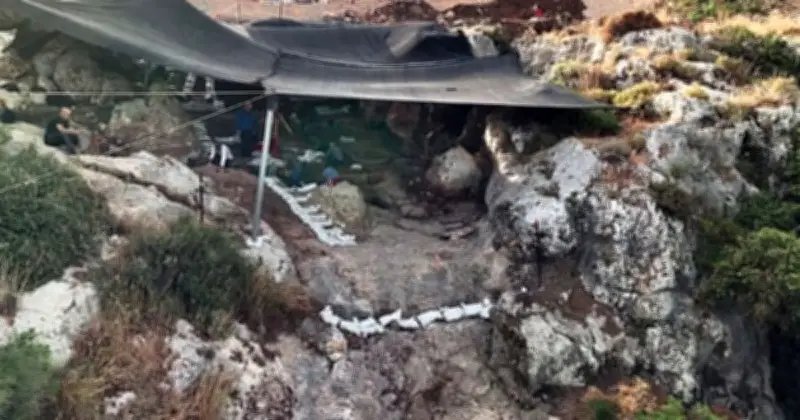
Archaeologists have uncovered a remarkably preserved prehistoric cave in Israel that offers an unprecedented glimpse into a pivotal period of human evolution, approximately 300,000 years ago. The site, near the town of Fureidis south of Haifa, contains stone tools, animal remains, and evidence of controlled fire dating to between 400,000 and 250,000 years ago. The cave remained largely untouched after its roof collapsed, sealing its contents and creating what researchers describe as a prehistoric "time capsule."
Evidence of Advanced Skills
The cave's inhabitants displayed surprisingly advanced skills for the period, according to researchers. Evidence shows they controlled fire, hunted a range of animals, quarried flint from nearby rock outcrops, and produced sophisticated stone tools. These behaviors are considered hallmarks of later Neanderthal and modern human societies.
Dr. Kobi Vardi, head of the Israel Antiquities Authority's Prehistory Branch and co-director of the excavation, told The Times of Israel: "This is probably the last culture of a very long continuum [of cultures]. Between 250,000 years and 50,000 years ago, Homo sapiens and Neanderthals created a totally different culture, so we are right in the moment of transition."

The Acheulo-Yabrudian Period
Experts believe the cave was occupied during the Acheulo-Yabrudian period, a little-understood era that predates the emergence of classic Neanderthals and modern humans. The excavation provides a rare look at a time when older human traditions were fading and behaviors associated with later populations were emerging.
Among the most significant finds were around 100 side scrapers, a defining feature of the Acheulo-Yabrudian culture, likely used for butchering animals and processing hides. Several finely crafted handaxes were also uncovered, noted for their advanced design compared to typical handaxes used for roughly one million years during the Palaeolithic period.
Who Were the Cave's Inhabitants?
No human remains have been found at the site, so researchers cannot say with certainty who occupied the cave. However, some scientists believe the population may have been descended from groups often classified as Homo heidelbergensis, widely regarded as the last common ancestor of Neanderthals and modern humans. The cave's occupants may represent a transitional population in the human family tree.
Vardi noted the rarity of such sites: "This is very important because sites from this phase are extremely rare; there are about ten sites in the Near East, two in Syria, one in Lebanon and six in Israel. However, this is the only site in the Carmel Ridge where this phase was discovered, where we have this culture in pristine condition, meaning not covered by later layers, except for a small part of the cave."
Daily Life and Environment
The findings suggest the cave's inhabitants possessed sophisticated survival skills. Animal remains include fallow deer, gazelles, ancient horses, and wild cattle, many bearing signs of human butchery. Scientists noted that animal bones of this age are rarely found in such good condition. Evidence suggests the community lived in relatively large, socially connected groups compared with earlier populations, and the cave may have been located beside a spring, providing a dependable water source.
Overall, the discovery is helping scientists fill significant gaps in understanding how ancient humans lived and adapted during a poorly documented stage of prehistory.