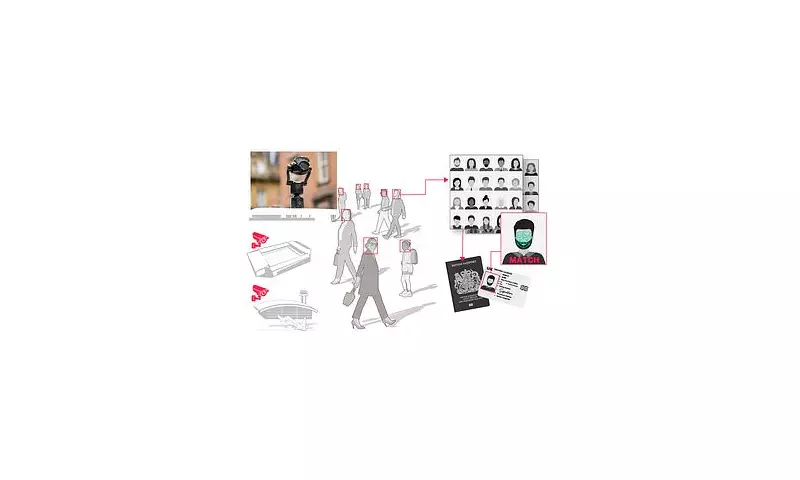
The widespread rollout of live facial recognition (LFR) technology risks turning public spaces into areas that some ethnic minority people feel compelled to avoid, according to a significant new government study.
Consultation Launched Amidst Public Concern
Ministers yesterday initiated a ten-week public consultation on the future use of emerging biometric technologies by police forces. These systems, which can analyse motions and emotions, are touted as tools to catch criminals, prevent suicides, and locate missing persons. However, a Home Office-commissioned study released alongside the consultation has highlighted profound public apprehension, particularly among minority communities.
The research found that minority groups were substantially more likely to avoid – or consider avoiding – town centres and other busy locations where LFR cameras are deployed. Specifically, 11% of ethnic minority respondents stated they would completely steer clear of a monitored area, with a further 21% saying they would think about minimising their time there.

The figures were even starker for black individuals, with 9% saying they would avoid the area entirely. This compares to just 4% of people overall and 3% of white people. The study also identified that men aged 16-34, lesbian, gay, and bisexual people, and those with a degree-level education or higher were more inclined to avoid zones with live facial recognition.
Persistent Questions Over Accuracy and Bias
These concerns are underpinned by evidence regarding the technology's accuracy. Testing commissioned by the Home Office itself supported fears that facial recognition cameras are less accurate when scanning faces from some ethnic minorities. A separate evaluation by the National Physical Laboratory, also published yesterday, identified an 'in-built bias' in police systems, leading to more false matches for black and Asian people than for white people.
The Home Office insists it has mitigated this 'bias' by altering the algorithm used to match faces against watchlists, claiming that after increasing the accuracy threshold, there was 'no significant demographic variation'. Despite this, public trust remains low: nearly half (47%) of black people and 36% from mixed or multiple ethnic groups believe the technology is biased.
The Association of Police and Crime Commissioners (APCC) warned that such technologies have been deployed "without adequate safeguards in place," stressing that robust, independent assessment and transparency are vital for public trust.
Plans for a Major Expansion of Surveillance
The consultation arrives as the government, led by Sir Keir Starmer, seeks to establish a new legal framework to enable a major national expansion of facial recognition. This could see cameras deployed in every police force area across cities, towns, and villages.
Plans extend beyond current LFR use. The consultation explores permitting 'inferential' cameras to analyse behaviour, such as CCTV at suicide hotspots alerting police when an individual 'repeatedly paces the area'. It also questions whether police should access wider government databases—including passport and driver's licence images—to track criminals.
Furthermore, civil servants are working on a new national facial recognition system capable of searching custody images, immigration records, and pictures of missing people. Crime and Policing Minister Sarah Jones argued a specific legal framework is needed for "confident, safe, and consistent use at significantly greater scale."
However, critics have sounded the alarm. Former Shadow Home Secretary David Davis MP condemned the proposals, stating: "It would be the framework of a surveillance state in everything but name." He questioned the move towards reading citizens' emotions to predict crime, calling the technology unproven.
Legal experts have also raised objections. Maria Theodoulou, Partner at Stokoe Partnership Solicitors, said: "Any deployment must meet strict tests of necessity and proportionality. Unless the Government introduces robust, enforceable regulation, widening police use of facial recognition will undermine confidence in both policing and the rule of law."

The debate places the government's crime-fighting ambitions on a direct collision course with growing concerns over privacy, accuracy, and the potential erosion of civil liberties for all, but particularly for already marginalised groups.