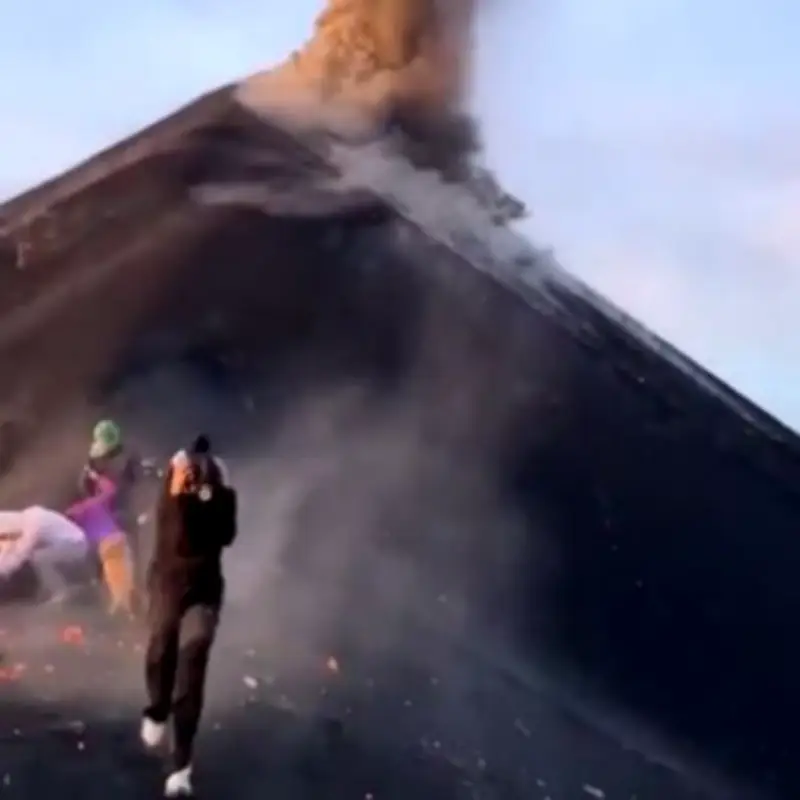
Tourists hiking up the Volcán de Fuego in Guatemala were suddenly pelted with red-hot lava when the volcano erupted without warning. Dramatic footage shows a chunk of rock striking the ridge and shattering into glowing fragments that flew in all directions, with hikers screaming and ducking for cover.
Harrowing Escape Caught on Video
The incident occurred during a strenuous ridge hike add-on to the popular Acatenango overnight trek. Hiker Hana Garcia captured the terrifying moment as molten rock burned a large hole straight through her coat. Sharing the images, Garcia wrote: "I wanted it to be the best day of my life, and it almost became the last." She later reassured followers that "the only thing that got hurt was my jacket."
Garcia told local media: "The volcano erupted and I managed to film a little bit of it, but I didn't record much because, while I was filming, I looked up and started seeing rocks falling." She described being in shock and then running as a piece of volcanic rock landed about "five centimetres in front of me" and "almost hit me in the head."

Unusual Event on Active Volcano
Fuego is almost constantly active at a low level, producing small explosions of gas and ash every 15 to 20 minutes. However, Garcia noted that such rockfalls on the hiking ridge are rare: "But we weren't expecting that accident with the rocks because they always fall on the other side. It's not something that usually happens. Lots of tourists have gone there, but nothing like this happens to them."
She described the experience as unforgettable and positive in a way, saying: "Now it's an unforgettable experience, and in a way a good one because it's something we survived. But at the time we were absolutely terrified."
Global Context of Active Volcanoes
There are roughly 1,500 potentially active volcanoes around the world, with numbers varying based on definitions. Scientists often separate volcanoes that could erupt again from those currently erupting. On the broadest definition, about 1,500 volcanoes are classed as "potentially active" because they have erupted at least once in the last 10,000 years and could erupt again. Around three-quarters of these sit around the Pacific Ocean's "Ring of Fire," where tectonic plates collide. A smaller group are volcanoes in "continuing eruption," with the Smithsonian Institution's Global Volcanism Program typically tracking about 40 to 50 such volcanoes at any one time.