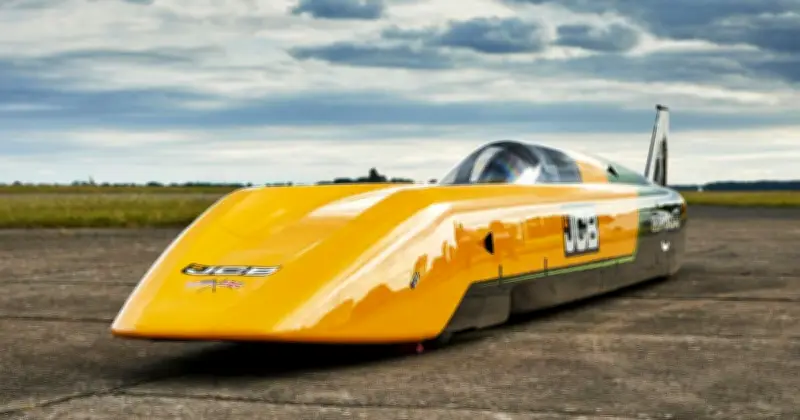
The JCB Hydromax, a British-built hydrogen-powered vehicle, is poised to become the fastest hydrogen car ever designed, targeting speeds exceeding 350mph. Construction group JCB is preparing for a Land Speed Record attempt on the famous Bonneville Salt Flats in August 2026, with testing already underway.
Five Years of Development and £100 Million Investment
JCB has spent five years developing hydrogen internal combustion engines as part of a £100 million investment in the technology. The company previously broke the diesel land-speed record with its Dieselmax model in 2006, clocking 350.092mph. Now, JCB hopes its hydrogen model will go even faster.
Technical Specifications and Performance
The Hydromax is fitted with two production engines that combine to deliver 1,600hp. Each titanium turbo compressor spins at more than 150,000 rpm at almost 300°C, according to Staffordshire-based JCB. The current hydrogen-powered land speed record stands at 302.877 mph, meaning the Hydromax could surpass it by a significant margin.

Hydrogen Technology Explained
FIA Land Speed Records Commission President Roger Banowetz explained the technology exclusively: “Hydrogen is stored on board as a compressed gas and delivered to the engine cylinders as a gas via special fuel injectors.” He added that a hydrogen vehicle capable of breaking the 350mph barrier “would make a clear statement.” Banowetz noted that hydrogen-powered land speed record vehicles remain rare, making projects like this significant: “They offer a valuable platform to test, understand and showcase the technology under some of the most demanding conditions in motorsport, helping demonstrate that hydrogen works for high-performance motorsport.”
Testing and Milestones
The JCB Hydromax has already been tested, hitting the runway at RAF Wittering earlier this week. Hydrogen cars are already available in the UK, such as the Toyota Mirai and Hyundai NEXO, but the technology has not taken off as quickly as EV batteries due to a lack of refuelling infrastructure. Last week, the Automobile Club de l'Ouest confirmed that hydrogen cars will be allowed to compete in the prestigious Le Mans 24 Hours race from 2030, a stepping stone that could see hydrogen become more mainstream by the end of the decade.
Environmental Benefits
Banowetz highlighted the environmental advantage of hydrogen combustion: “For hydrogen combustion, one clear advantage is that the engine exhaust is water vapour. This makes it one of the cleanest internal combustion fuel options from an exhaust emissions perspective, while still allowing engineers to pursue the performance characteristics associated with a combustion engine.”