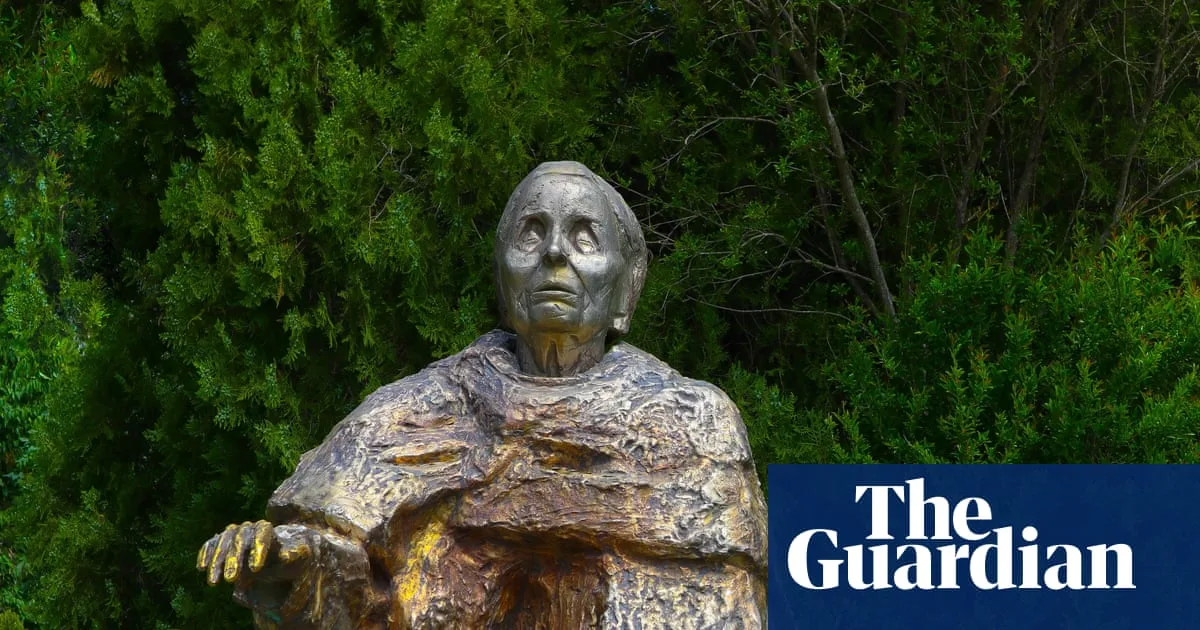
In some corners of the internet, the Bulgarian mystic Baba Vanga has taken on mythical proportions. Social media and tabloids across the globe credit her with predicting the 9/11 terrorist attacks, the Covid-19 pandemic and the war in Ukraine. Last week, some headlines asked: “Did she foresee the Israel-Iran war, US interference, missiles and airspace shutdowns?” An earlier article mused on her “predictions for 2026”, which purportedly included the start of world war three and humanity’s first contact with aliens.
Such claims garner clicks, but a chorus of voices from Bulgaria and beyond has warned many of the prophecies attributed to Vanga were probably never said by her. Instead, they say, the so-called “Nostradamus of the Balkans” has become a potent avatar, used for everything from sensationalised clickbait to the pushing of pro-Russian narratives. “It’s absurd,” said Ivan Dramov of the Bulgaria-based Baba Vanga Foundation as he listed off false claims – amplified on TikTok, YouTube and publications that range from UK tabloids to Albanian state-run media – of Vanga’s visions of nuclear catastrophe or world wars.
“Absolute lies have been told about this holy woman,” said Dramov, whose organisation was launched by Vanga’s followers and was chaired by Vanga herself in the years before her death. “Vanga dealt mainly with people’s health problems, not with upcoming cataclysms in the world.” Known around the world as Baba Vanga, Vangeliya Pandeva Gushterova was born in 1911 in what was at the time the Ottoman Empire. As a teenager, she was said to have been thrown into a field by a tornado, leading to the gradual loss of her eyesight.

She found herself in the local limelight during the second world war as people began visiting her to find out whether their loved ones would return from the front, said Dramov. By the 1960s, she was a regional phenomenon, attracting crowds to Petrich, the south-western Bulgarian town where she lived with her husband. As her reputation spread beyond national borders, visitors began arriving from countries such as Russia, Romania and Greece. Vanga’s pronouncements were often tightly focused on the lives of those who came to see her, as well as their relatives, said Dramov. “She told people which doctor to go to, what actions to take, but nothing more.”
Her star soon began to rise internationally, as TV series, books and talkshows delved into her life and prophecies. Among those who eagerly embraced Vanga were Russians, with the Bulgarian becoming “one of the most noteworthy mediums of ‘truth’ in 20th- and 21st-century Russian imagination,” researchers at the University of Texas at Austin noted in 2024. Much later on, with the advent of social media, mentions of Vanga multiplied. Her imprint on Russian culture was such that she inspired a verb, vangovat, meaning to predict, as well as an expression that roughly translates as: “How should I know, do I look like Baba Vanga to you?”
Today, her name and supposed prophecies are commonly referenced in Russia, at times to bolster Kremlin-aligned political narratives. The result is a combination with a far-reaching impact: a 2024 report on disinformation by the media organisation BIRN Albania, which surveyed 36 Albanian publications over a year, found at least a dozen articles, most of them citing Russian media, in which Vanga’s predictions were “often used by conspiracy and disinformation media to reinforce certain narratives against Nato and the EU”. Russians’ eager embrace of Vanga belies the fact that the Bulgarian is unlikely to have said much at all – at least explicitly – about Russia, said Viktoria Vitanova-Kerber, a PhD student and research assistant at the Chair for Global Christianity and Interreligious Theology at the University of Fribourg. Instead, many of the predictions attributed to Vanga, from the fall of the Soviet Union to visions of a glorious future for Russia, can be traced back to the Russian writer Valentin Sidorov, who claimed to have met Vanga in the 1970s. “There are, however, no recordings of these meetings, which allowed Sidorov a free interpretation, or possibly even construction of what Vanga has or has not said about Russia,” said Vitanova-Kerber.