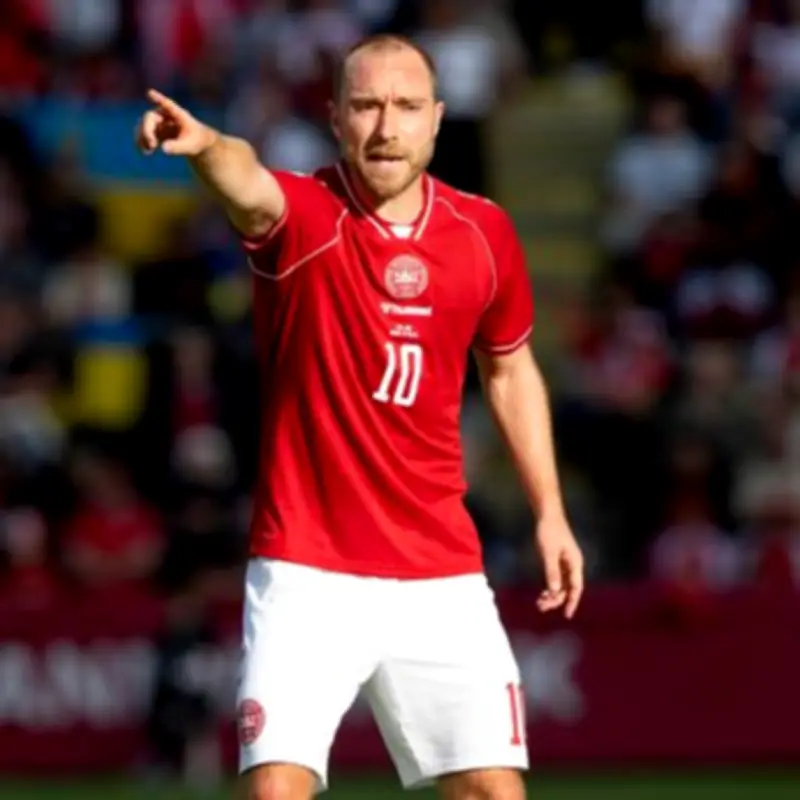
There was an immediate silence at the Nature Energy Park on Sunday evening as Christian Eriksen, for the second time in his career, collapsed on the pitch. The former Manchester United, Tottenham and Brentford midfielder clutched his chest before falling to the ground and briefly losing consciousness in the 65th minute of Denmark's friendly with Ukraine in Odense. Medical personnel rushed to the Wolfsburg star's aid, and he was able to walk to the ambulance.
According to Denmark's national team doctor Morten Boese, the 34-year-old is now “doing well” and is expected to be discharged to return home “soon.” However, the episode comes five years after his terrifying ordeal at Euro 2020.
Eriksen's Previous Collapse at Euro 2020
Eriksen had been part of the Danish starting side for their opening clash with Finland at the Parken Stadium in Copenhagen when he collapsed with nobody around him. His heart stopped for roughly five minutes as he received immediate CPR from team-mate and then-captain Simon Kjaer before a defibrillator was used. Eriksen regained consciousness on the pitch before he was rushed to a nearby hospital. It was at the hospital that Eriksen was fitted with an implantable cardioverter-defibrillator (ICD), which can detect dangerous heart rhythms and deliver corrective electrical shocks if necessary.

How the ICD Device Works
An ICD is placed in a small pocket under the skin or muscle just beneath the collarbone and can fit in the palm of your hand. Eriksen made a remarkable return to top-flight football, turning out for Brentford, Manchester United and Wolfsburg. However, his playing career could be up in the air after Sunday, where his ICD seemingly shocked him during the friendly. Boese said: "As I see it, the pacemaker responded as it should. He was briefly unconscious, but regained consciousness very quickly, and we were quickly in contact with him."
Explaining to Daily Star Sport how it works, top UK doctor Dr Gareth Nye said: "Your heart relies on electrical signals to beat in time and keep you alive. Sometimes your heart beats slower than normal, other times it needs to beat quicker. In normal circumstances, our brain and body deal with this itself. In some people, the heart rhythm may not be consistent and needs support. A pacemaker constantly watches your heart rate. If your heart starts beating too slowly, the pacemaker sends a tiny electrical nudge to tell it to beat. You won't feel it, but you may feel the effects as symptoms disappear.
"An ICD is designed for a much more dangerous problem. Some people are at risk for their heart suddenly beating incredibly fast and out of rhythm, called ventricular fibrillation or tachycardia. When this happens, the heart quivers instead of pumping blood, which causes sudden cardiac arrest. If the ICD picks up on this change, it immediately delivers a larger electrical shock to reset the heart back to a normal rhythm. People feel this going off and describe it as a kick to the chest. The hope is the shock is sufficient to restart the heart into a normal rhythm. I assume this occurred to Eriksen last night."
Further Tests and Comparisons
This, however, is yet to be confirmed, and he will undergo further tests to see if his ICD worked as it should. It will also give him a greater chance of getting a condition diagnosed. Former England cricketer James Taylor experienced an ICD shock after he was diagnosed with Arrhythmogenic Right Ventricular Cardiomyopathy (ARVC), similar to the condition which affected footballer Fabrice Muamba. It's a condition that means he can no longer undergo vigorous exercise, and the Nottinghamshire star was forced to retire from the sport in 2016.
Speaking the following year, he explained how it had gone off once and the frightening impact. He said: "The defibrillator has kicked in with real force. It shot me a few yards across the room, probably because I'm small. That's probably why I've got the anxieties I have now and I'm a little bit scared of exerting myself or pushing myself in some way. I know the feeling when it does go off, when things aren't quite right. It's a scary feeling and it hurts. It does its job, that's the most important thing."

Welsh centre-back Tom Lockyer, 31, now of Bristol Rovers, was also fitted with one after he suffered a cardiac arrest when playing for Luton Town in a Premier League clash with Bournemouth in December 2023. It was his second cardiac event after suffering an atrial fibrillation during the Championship play-off final. Meanwhile, WWE wrestler-turned-chief content officer Triple H, real name Paul Levesque, 56, has ruled out a return to the ring after he was fitted with an ICD following a cardiac event. He explained: "I would never wrestle again. First, I have a defibrillator in my chest. Which, it's probably not a good idea for me to get zapped on live TV."