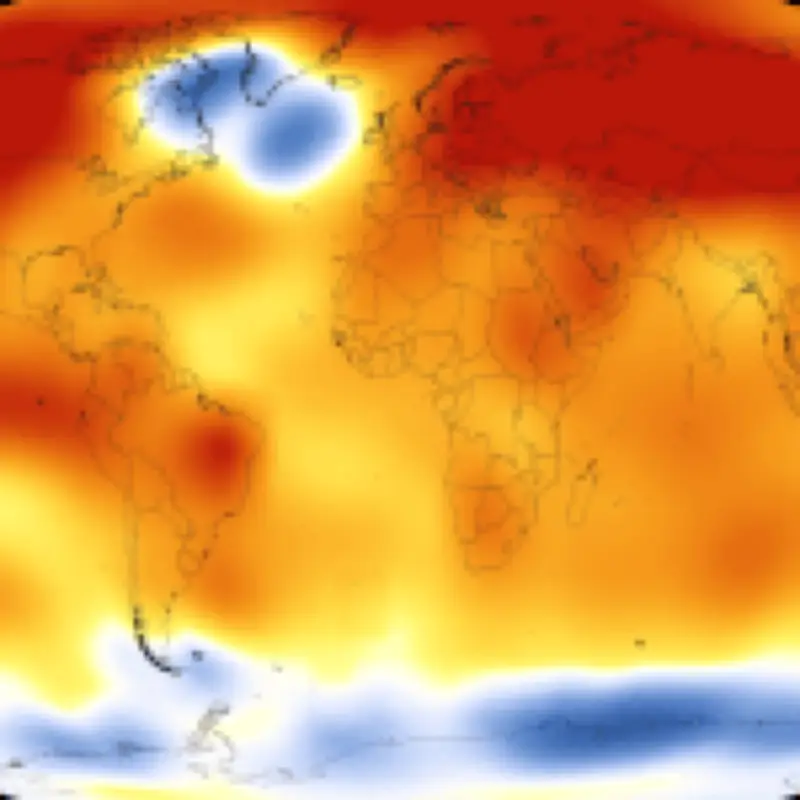
A mysterious cold blob in the North Atlantic, located southeast of Greenland, has puzzled scientists for decades. This region, also known as the 'warming hole,' has cooled by up to 1°C over recent decades, contrasting with global warming trends. Now, researchers suggest that the Atlantic Meridional Overturning Circulation (AMOC), a system of ocean currents, is weakening and causing this anomaly.
What Is the Cold Blob?
The cold blob is a large patch of ocean that has defied the general pattern of rising temperatures. While the planet warms, this area has become cooler. Scientists have debated its cause, with some attributing it to wind patterns and cloud cover. However, a new study published in Geophysical Research Letters points to a weakening AMOC as the primary driver.
Understanding AMOC
AMOC acts like a conveyor belt, carrying warm, salty surface water from the tropics to the North Atlantic, where it cools and sinks. This process influences weather patterns globally. A slowdown could have cascading effects, particularly for Europe.

Lead author Wei Liu, a climate scientist at the University of California Riverside, explained that the cold blob extends 1,000 meters deep, indicating that ocean processes, not just atmospheric ones, are key. 'People have been asking why this cold spot exists. We found the most likely answer is a weakening AMOC,' she said.
Evidence and Implications
Using climate reanalysis data from boats and satellites, Liu's team traced heat loss from the ocean surface in the blob back to 1955. They found a decrease in heat loss, aligning with AMOC weakening. Co-author Stefan Rahmstorf of the Potsdam Institute for Climate Impact Research noted that wind and clouds explain only a 'modest fraction of the warming hole.'
The weakening is driven by freshwater from melting Greenland ice sheets diluting the salty tropical waters of the Gulf Stream, a part of AMOC. This slowdown could reduce heat transport to northern Europe, leading to colder winters. Jim Dale, a meteorologist with British Weather Services, warned that AMOC is a major 'tipping point' of climate change.
Potential Consequences
- Europe: Winters could become akin to Canada, with deep snow and frigid temperatures.
- North America: Sea levels may rise rapidly along the coast.
- Africa and Asia: The Sahel and monsoon regions could see reduced rainfall.
Dale emphasized that while this hasn't happened yet, it is a major consequence of anthropogenic global warming. 'The result is the future potential for a disruption of the AMOC and life as we know it in northwest Europe,' he said.
Uncertainties Remain
Not all scientists are convinced. Some argue that AMOC may not be weakening, citing a strengthening Norwegian current that could absorb heat. However, Dale noted that the cold blob has long 'stood out like a sore thumb' and is 'almost certainly caused by melting ice off the Greenland ice sheet seeping into the ocean.' Researchers acknowledge that data is not conclusive, and alternative explanations cannot be ruled out.
The study adds to growing concerns about climate tipping points. As the planet warms, the AMOC is projected to weaken by at least 20% by 2100, with a potential shutdown over time. Such a change would dramatically alter ecosystems and human societies.