
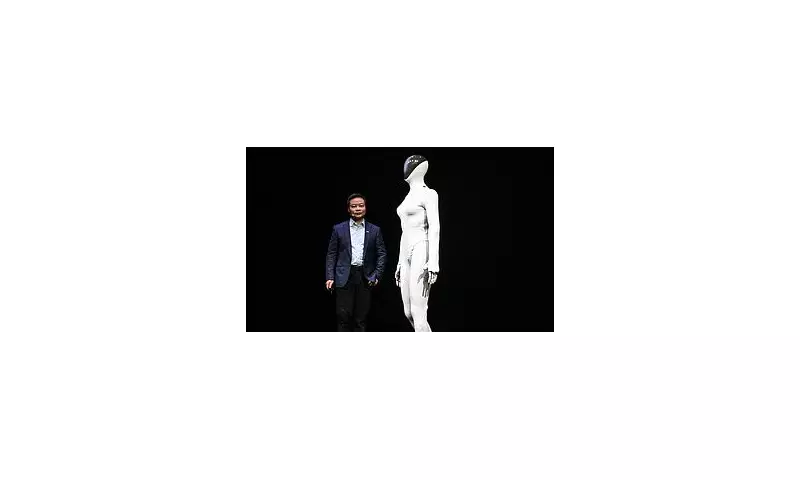
In a stunning demonstration that blurred the lines between machine and humanity, Chinese electric vehicle manufacturer Xpeng has unveiled a humanoid robot so realistic that its creators were forced to perform live surgery to convince sceptical audiences.
The Uncanny Valley Breakthrough
During the company's 2025 XPENG AI Day in Guangzhou, China, Xpeng revealed its latest creation: the Xpeng IRON humanoid robot. The robot's movements proved so eerily lifelike that many observers refused to believe they weren't watching a human performer in an elaborate costume.
Faced with mounting scepticism, Xpeng engineers took dramatic action. Before the assembled crowd, an engineer carefully cut through the robot's synthetic skin with large scissors, revealing not a hidden human as some critics had suspected, but sophisticated synthetic muscles and a sleek metal endoskeleton.
Advanced Technology Behind the Realism
The secret to IRON's unnerving realism lies in its sophisticated artificial intelligence system and unique mechanical design. The robot is powered by three custom AI chips capable of performing 2,250 trillion operations per second (TOPS), making it one of the most advanced humanoid robots ever created.
This immense processing power enables the robot to move with human-like balance and poise, reacting physically to its surroundings in real-time. The company describes its walking pattern as a 'cat-like' gate, produced by an innovative system of artificial muscles, flexible bones, and a synthetic spine.
Adding to the uncanny effect is what Xpeng calls a 'full coverage' synthetic skin, which the company claims makes the robot 'feel warmer and more intimate' to human interaction.
Public Reaction and Future Applications
Social media erupted with amazement following the demonstration. One impressed commenter captured the general sentiment perfectly: 'For the first time in human history, a robot needs to prove that it is a machine.'
Another observer noted: 'It's a compliment to the engineers that people thought it was a disguised human.' The level of realism achieved by Xpeng clearly struck a chord with technology enthusiasts worldwide.
He Xiaopeng, chairman and CEO of Xpeng Motors, outlined an ambitious vision for the future of humanoid robotics. 'In the future, robots will be life partners and colleagues,' he stated at the event. He suggested that customers would eventually be able to customise their robots' build, skin tone, sex, hair length, and clothing according to their preferences and intended purposes.
Despite the convincing demonstration, some social media users remained sceptical. 'It's a woman with a prosthetic leg,' one commenter insisted, while another demanded: 'Cut open all of it! It could be an amputee!' However, there is no evidence to support these claims, and IRON represents the second generation of humanoid robots developed by Xpeng.
Practical Implementation and Safety Considerations
Xpeng has confirmed that the first IRON robots will begin appearing at company locations in 2026, primarily working in factory settings. The company has ruled out domestic applications for now, citing obvious safety risks posed by placing such powerful autonomous robots in unpredictable home environments filled with clutter.
While the company didn't disclose pricing information or respond to requests for additional details, the demonstration marks a significant milestone in robotics development. The IRON robot represents not just technological achievement but also the psychological challenge of creating machines that increasingly resemble their human creators.