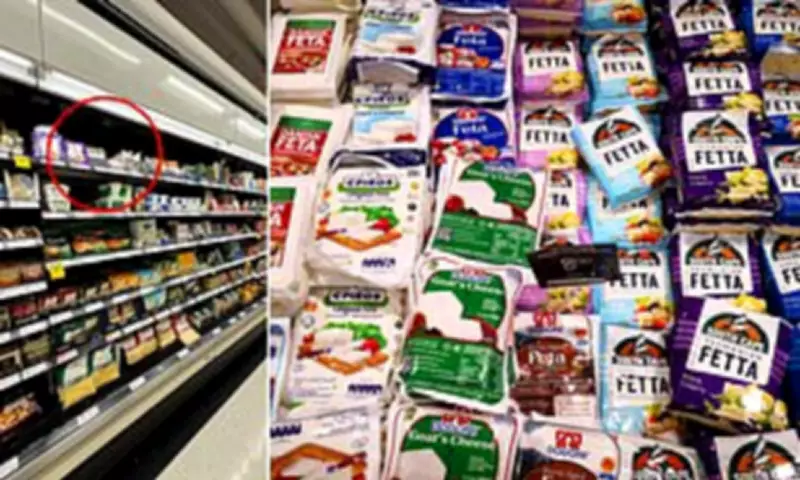
Shoppers are expressing astonishment after discovering that a single letter can make a significant difference between cheese labeled 'feta' and 'fetta'. Sylvia, a nutrition enthusiast from Sydney, shared her revelation after noticing that her Greek salads were not tasting as expected. Upon closer inspection of the label, she realized the spellings were different.
'I had no idea that "feta" and "fetta" weren't the same thing,' she said in a video that has since garnered over 60,000 views. Her research revealed that 'feta' is the authentic version made with sheep's milk in Greece, while 'fetta' is a non-traditional variety produced from cow's milk in countries such as Australia and Denmark.
The Authentic Difference
'Feta is the real deal. Made in Greece using traditional ingredients and methods,' Sylvia explained. 'Fetta can be lower in salt, fat and calories, but with a different taste and texture.' She noted that 'feta' is a protected name under European Union law, meaning only cheese produced in Greece using sheep's or goat's milk can be labeled as such. This protection, known as Protected Designation of Origin (PDO) status, was granted by the European Commission in 2002 after a lengthy legal battle with Denmark, Germany, and France, according to CHOICE.

Traditional feta sold in the EU must contain at least 70 per cent sheep's milk, with goat's milk often making up the remaining 30 per cent. Because authentic feta is imported, it tends to be more expensive than Australian Greek-style varieties. 'The Greek-style ones are made using cow's milk. They're a bit cheaper and they've got a milder taste. They're not bad, just different,' Sylvia added.
Public Reaction
Many viewers admitted they had never noticed the spelling difference before. 'I've been eating feta for 30 years and never noticed,' one commenter shared. Another said, 'Whoa thanks for this, I had no idea. I thought they were all made with sheep's milk.' Some offered additional tips: 'Authentic feta comes in a container in liquid brine. If it comes wrapped in plastic it's still not the real deal.' Another viewer reflected, 'In Greece, they told us this but I thought nah... but I see now they were right.'
Greek Yoghurt Debate
The feta versus fetta discussion comes on the heels of a similar debate about yoghurt. Dr Karl Kruszelnicki recently pointed out that yoghurts labeled 'Greek' or 'Greek style' are not the same. Traditional Greek yoghurt is made by straining to remove whey, resulting in a thicker, protein-rich consistency. Greek-style alternatives often contain additives like thickeners (gelatin), gum, and milk solids to mimic the texture without the lengthy straining process.
Dr Karl highlighted that Greek-style yoghurts contain emulsifiers—additives used to keep ingredients blended without separating—which could potentially harm our health. In his podcast Shirtloads of Science, he discussed with Professor Clare Collins, an Australian dietitian and Professor of Nutrition and Dietetics at the University of Newcastle, the effects of emulsifiers on the gut.
Health Implications
Professor Collins explained that emulsifiers in some processed foods can affect gut bacteria, known as microbiota. 'There's been an assumption that with these food additives, your body doesn't absorb them, so what's the problem?' she said. 'But now there's more recognition that some of these food additives can go through the loops all the way down to the large intestine, get to the very last section of the colon where all the bugs live, and the microbiota can have a field day with them.'
She warned that emulsifiers could disrupt the gut bugs and potentially damage the gut wall, leading to a 'leaky gut' where unhealthy bacteria slip through, increasing the risk of allergies, inflammatory bowel conditions, or diarrhea. Professor Collins compared emulsifiers to dishwashing liquid: 'You have a dirty baking dish. If you squirt that on, what it does is it can really break down all of those fats, and that's kind of the same effect on your intestinal wall.'

To avoid emulsifiers, she advised checking labels for chemical names such as 'soy lecithin' or 'polysorbate 80', or numbers often in the 400 range. However, she urged shoppers not to panic. 'Go to Food Standards Australia New Zealand (FSANZ) and download the food additives list. I think it's worth it, save it to your phone, so you know what numbers and words you're looking for.'