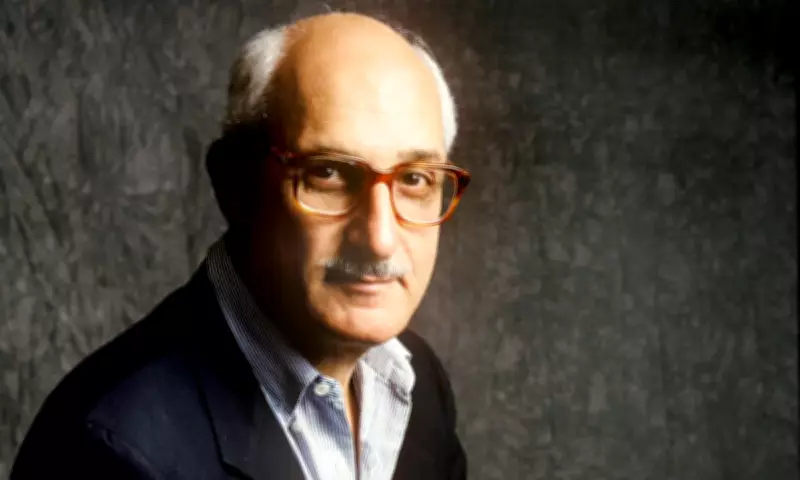
David Malouf, the acclaimed Australian author best known for novels such as Ransom, An Imaginary Life, and the Booker Prize-nominated Remembering Babylon, has died at the age of 92.
Malouf passed away on Wednesday, according to a statement released by his publisher, Penguin Random House Australia, on Thursday. The publisher expressed deep sadness, noting that Malouf wrote across fiction, non-fiction, poetry, libretti, and plays, leaving a significant and lasting impact on Australian literature.
Throughout his career, Malouf won numerous prestigious awards, including the Miles Franklin Award, the Commonwealth Writers' Prize, the Prix Femina Etranger, the IMPAC Dublin Literary Award, and the Australia-Asia Literary Award. He was also a respected teacher and lecturer in both Australia and Europe.

Beyond his literary achievements, Malouf was remembered as a loyal and loving friend, devoted to his family, and a passionate supporter of Opera Australia, Adelaide Writers Week, and the Indigenous Literacy Foundation.
Early Life and Career
Born in Brisbane in 1934 to a Lebanese Australian father and an English-born mother of Portuguese and Sephardic Jewish descent, Malouf was an avid reader from an early age, reportedly finishing the complete works of Shakespeare by the age of 10.
He began his writing career with poetry, often drawing inspiration from his childhood, family, travels, and his connections to both Europe and Australia. His first published work appeared in 1962. Malouf was also a gifted short story writer, releasing five collections over three decades.
Notable Works
His debut novel, Johnno (1975), was semi-autobiographical, depicting a young man growing up in Brisbane during World War II. However, it was Remembering Babylon (1993) that brought him international recognition. The novel, which tells the story of a young shipwreck survivor rescued and raised by Aboriginal people, was shortlisted for the Booker Prize and won the Commonwealth Writers' Prize and the first International Dublin Literary Award.
Much of Malouf's writing delved into the past—his own childhood, great myths, and colonial Australia. Critic Rick Gekoski noted in 2011, "He has a poet's sensibility, but there is nothing brazenly poetic about his prose. One is constantly astonished by the vivacity and accuracy of the writing."
Malouf's final novel, Ransom (2009), came after a 13-year hiatus. It retells the story of Priam's appeal to Achilles for the return of his son Hector's body from Homer's Iliad. The book received global acclaim and was shortlisted for the International Dublin Literary Award. His last published book was a poetry volume, An Open Book (2018).
Personal Life and Legacy
Malouf was openly gay for much of his life but remained discreet about his relationships, even after achieving fame. Close friends often reported knowing little about his personal life.
Despite being hailed as a great chronicler of Australia, Malouf rejected the label of a representative Australian. He once said, "I don't consider myself a representative Australian and I'm not a representative Queenslander. Each one of us is individual and we take exactly what suits us best. We can be whatever we want to be."
Fellow author Helen Garner remembered Malouf for his kindness, encouragement, and love of laughter. She recounted how he provided practical help during her early career and noted his wit and warmth. "Foolishly, I imagined he would live on for ever in his high apartment up there in Surfers (Paradise). I'm shocked and sad to hear that he's gone," she said.
Malouf's contributions to literature and his impact on Australian culture will be long remembered.