

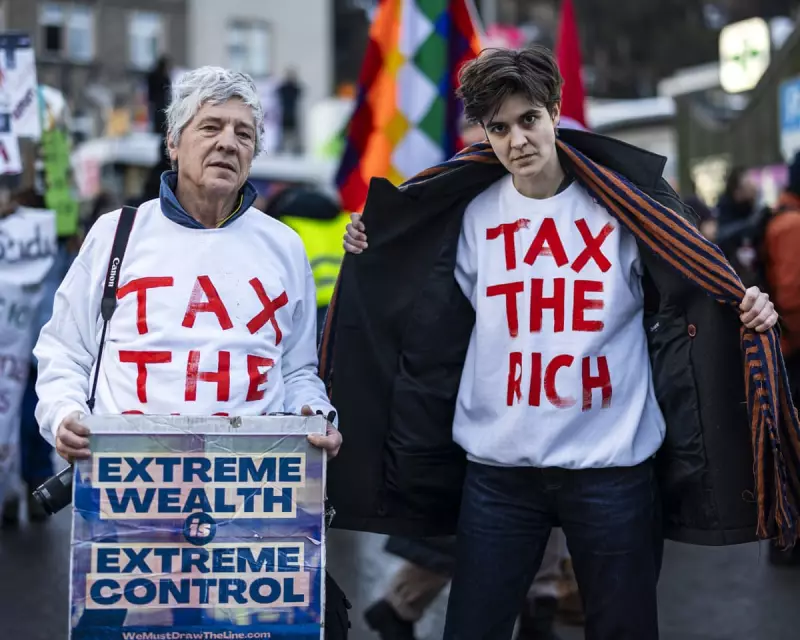
As the global elite convenes at the World Economic Forum (WEF) in Davos, Switzerland, this week, a glaring omission shadows their agenda. While hundreds of political leaders and corporate chiefs discuss the planet's most pressing threats, one fundamental cause remains conspicuously absent from official dialogue: neoliberal capitalism.
The Unnamed Risk at the Heart of the Crisis
In preparation for the 2026 meeting, the WEF published its Global Risks Report, identifying geo-economic confrontation, misinformation, and social polarisation as top short-term dangers. For the coming decade, environmental catastrophes lead the list. Notably, income and wealth inequality ranks seventh, yet the report's analysis acknowledges it as a central connecting factor for other perils.
According to economist and philosopher Ingrid Robeyns, this framing misses the point entirely. The problem is not merely about perceived exclusion or limited social mobility, as the report suggests. It is a fundamental issue of how the wealth generated by society is distributed. The neoliberal ideology dominant since the late 1970s, characterised by privatisation, shifting power from labour to capital, and reduced taxes for the rich, has created a system where wealth concentration erodes democracy.

A System Built for the Few, Discussed by the Few
The refusal to scrutinise this system in elite forums like Davos is illogical, Robeyns argues, because it is the primary driver of the very risks on the agenda. The economy is an interconnected ecosystem. High-profit sectors rely on public goods and a workforce sustained by often underpaid public servants—teachers, NHS staff, and care workers. Yet decades of policy have widened the chasm, making capital owners richer and workers poorer, while tax burdens have shifted from wealth to labour.
In her book, Limitarianism: The Case Against Extreme Wealth, Robeyns documents the social, ecological, and political damage caused by billionaires and centimillionaires (those with wealth exceeding $100 million). This requires a system-level analysis that challenges the status quo. Historical analysis supports this urgency. Economic historian Guido Alfani notes that extreme wealth was historically tolerated because the rich aided society in crises—a trend now reversing. Researcher Luke Kemp, studying civilisational collapses, identifies extreme inequality as a key predictor of downfall, presenting a stark choice: radical societal change or global collapse.
The Wealth Defence Industry and a Silent Elite
So why does Davos avoid this core debate? The answer, Robeyns contends, is straightforward: the attendees benefit from the current system. An increasing share of wealth flows to the top 1%, while the next 9% often work in what scholars term the "wealth defence industry," protecting the fortunes at the pyramid's peak. This elite has propagated a false ideology that neoliberal capitalism is the best possible system for all, deflecting questions about alternatives.
The WEF's Global Risks Report contains zero references to capitalism, socialism, or social democracy, ignoring vast academic scholarship on systemic alternatives. The economic system, Robeyns reminds us, should exist to ensure all people can live good lives within a just society and planetary boundaries. Neoliberal capitalism fails this test. Until its role is honestly examined by those in power, the world's key problems can neither be fully understood nor solved. The protesters outside the Davos summit point to a truth the conference halls work hard to silence.






