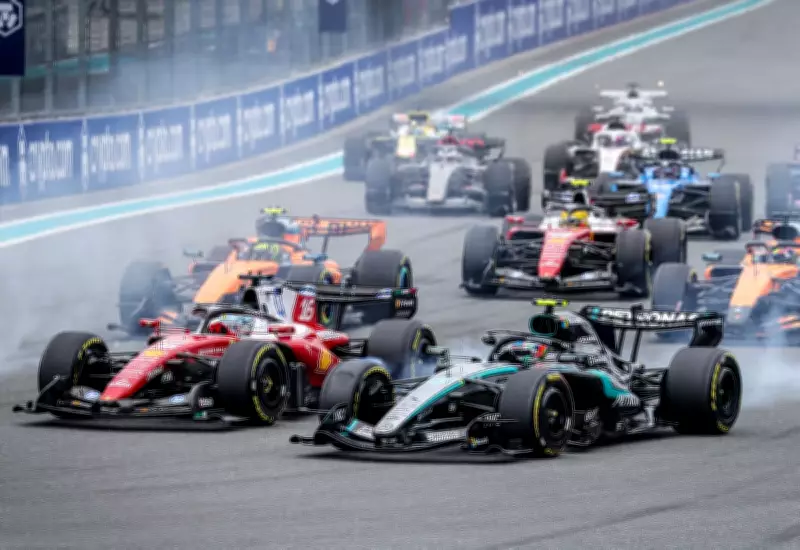
There is a long way to go, but after Formula One emerged from its enforced early season break with an entertaining race at the Hard Rock Stadium in Miami, it indicated that there may yet be a decent tale to be told this season—one where Mercedes do not have it all their own way.
Regulation changes dominated the buildup, but what really mattered in Miami was the sporting imperative of upgrades making a competitive difference. Mercedes had looked ominously strong with three straight wins in the opening three rounds before the five-week break caused by the cancellation of the Bahrain and Saudi GPs. During that time, there was no little beavering across the paddock on upgrades for Miami. McLaren, Red Bull, and Ferrari all brought big packages. Notably, Mercedes did not.
The results palpably demonstrated there are huge gains to be made with these new regulations, and the season will be defined by a fierce development war. McLaren and Red Bull made giant steps. Lando Norris and Oscar Piastri took a one-two in the sprint for McLaren, and Norris could well have beaten the race winner, Mercedes' Kimi Antonelli, but for a pit stop decision and its execution. They had bounded up to the front once more in Miami, a happy hunting ground for the team. Team principal Andrea Stella believed Mercedes still had between one and two tenths on them, but on track, Norris never looked that far off.

Red Bull, too, were transformed. So uncompetitive for three races, they brought aero upgrades and steering adjustments, and Max Verstappen suddenly found the car he had been looking for, coming alive with typical verve. He claimed second on the grid, and but for a spin on the opening lap, he would surely have been in the mix for the win.
Ferrari would be disappointed after not quite making the same strides as their rivals. Charles Leclerc looked to be a genuine contender for the win, but his early pace faded—a pattern that has been seen in other races this season—and he noted the lack of race pace and severe tyre degradation. Their car has the potential, but they have not matched McLaren or Red Bull.
Indeed, McLaren have more to come, with another swathe of developments for the next round in Canada, including a new front wing. Mercedes will also bring their first major upgrade to the W17 in Montreal. We have a fight that will run and run, not least because no development at this stage is wasted, given at the very least it can still inform next year's car. This is an engineering contest set to burn white-hot.
Somewhat more lukewarm was the reception to the regulation changes imposed in an effort to end driver dissatisfaction with energy management. The adjustments, effectively tweaks to the parameters of recovery and deployment of electrical energy, received an underwhelming response. They were welcomed but were clearly not sufficient to silence the drivers' vocal unhappiness with the new formula. Norris perhaps summed up the feeling in noting drivers were still penalised for pushing the cars and that the only answer was to 'get rid of the battery'. That view was shared by Verstappen, even though he enjoyed a much more competitive car in Miami. 'It's still punishing you. The faster you go through corners, the slower you go on the next straight,' he said.
Moreover, this was the reaction at what is considered an 'energy-rich' track, where a surfeit of heavy-braking areas makes for plentiful energy recovery and diminishes the aspects most disliked by drivers—the having to lift and coast or employing super-clipping, where the battery is charged when at full throttle, slowing the car. How they perform at what are considered the more 'energy-starved' circuits will likely revive the chorus of disapproval.

Part of the problem that has become increasingly clear after four races is that the sport is at something of an impasse. The drivers are clearly not happy, but F1 is cock-a-hoop at how the new regulations have led to far more overtaking. It is inarguable that the crowd in Miami roared their approval as Leclerc, Norris, and Antonelli duked it out in the early stages of the race. This yo-yo or Mario Kart effect is one some enjoy and some do not. Critics consider it as artificial as the previously derided DRS, but F1 insists the fan feedback is very positive, while Mercedes team principal Toto Wolff noted that anyone who did not find the race in Miami entertaining should 'hide'.
Which is the dichotomy of F1 in 2026 after Miami. What is inescapable is that having the stars of the sport still saying they don't like actually driving their cars cannot be glossed over by any amount of power-up overtaking.