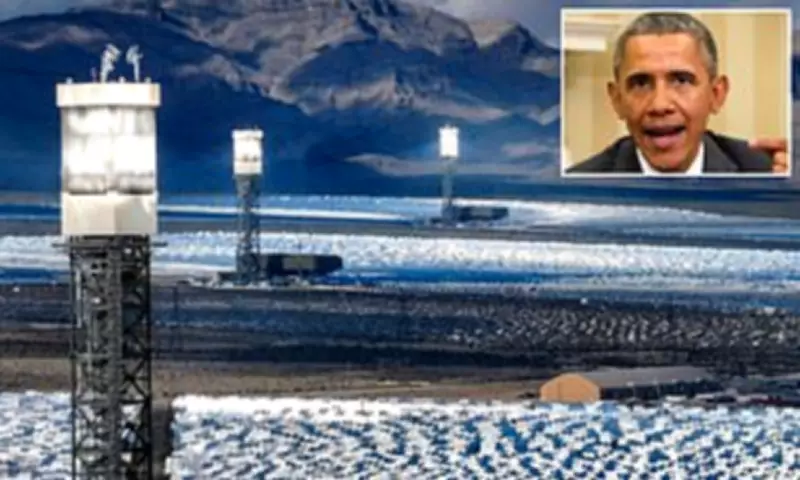
A $2.2 billion solar power plant in the California desert, backed by former President Barack Obama and funded partly by taxpayers, may now lead to higher electricity costs for Americans. The Ivanpah Solar Power Plant, a sprawling 3,500-acre facility in the Mojave Desert near the California-Nevada border, was constructed with federal support during the economic stimulus push under Obama's first administration.
Project Overview and Costs
The plant was designed to help revive the U.S. economy after the 2008 financial crisis while expanding renewable energy. It features approximately 350,000 computer-controlled mirrors and three 459-foot towers. The mirrors concentrate sunlight to heat water in the towers' boilers, producing steam that generates electricity.
According to federal data cited by Fox News Digital, between $730 million and $780 million of a $1.6 billion government-backed loan tied to the project remained unpaid. The U.S. Treasury also provided a $539 million grant, covering roughly 30 percent of construction costs.

Efforts to Shut Down the Plant
Both the Trump and Biden administrations have considered closing the plant due to its underperformance relative to cost, but California regulators have blocked those efforts. If the plant is closed, taxpayers could be left responsible for hundreds of millions in losses tied to the loan. However, if it remains open, consumers could face approximately $100 million more in annual electricity costs compared to newer technologies.
Daniel Turner, founder of the energy advocacy group Power The Future, described the plant as a "boondoggle" and said it makes "no economic sense to keep afloat." He added, "At some point, you have to stop throwing good money after bad."
Technological Obsolescence
Originally, Ivanpah represented a major expansion into relatively new solar technology. The project scaled up from smaller pilots to a nearly 400-megawatt facility, though its long-term performance was uncertain. Ultimately, the solar industry evolved faster than expected, as cheaper and more efficient photovoltaic panels, often paired with battery storage, surpassed Ivanpah's concentrated solar technology.
Severin Borenstein, an energy expert at the University of California Berkeley, noted that Ivanpah's approach is "no longer really competitive." He explained that when the plant was planned, solar thermal looked promising, but photovoltaic costs fell much faster than anticipated, changing the economics entirely. Borenstein warned that shutting down the plant would be difficult despite its inefficiency, as these are long-lived assets with long-term contracts.
Regulatory and Environmental Concerns
Pacific Gas & Electric, which buys electricity from Ivanpah, has described the contracts as part of an effort to reduce "uneconomic resources" in its energy portfolio. Southern California Edison, another buyer, has also discussed a buyout of its Ivanpah contract. However, in December, the California Public Utilities Commission rejected efforts to terminate the contracts, citing potential strain on the state's power grid and over $300 million in stranded transmission and infrastructure costs.
The plant has also faced criticism from environmentalists for harming local wildlife. Approximately 6,000 birds die each year due to the plant's high towers and intense rays from its mirrors, according to the Los Angeles Times. Environmental groups have also raised concerns about the plant's impact on tortoises.