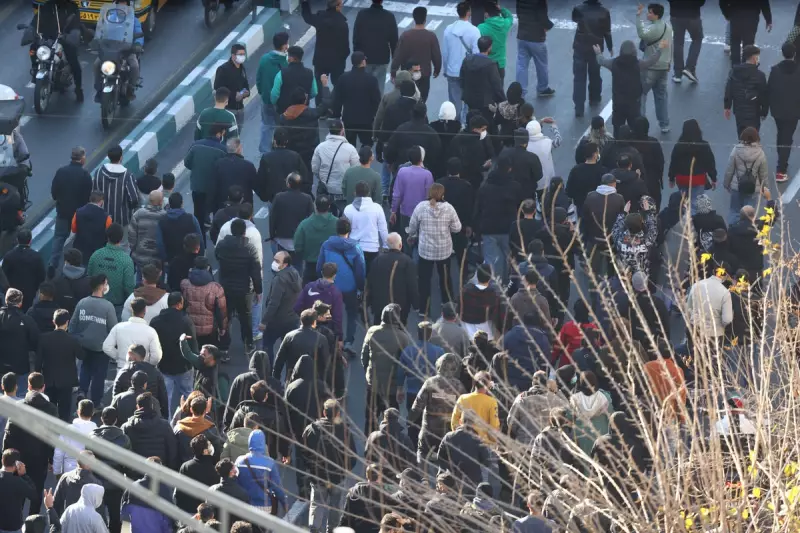
At least seven people have been killed in Iran as widening protests, sparked by the country's severe economic crisis, spread from the capital into rural provinces. The fatalities, which include both security force members and demonstrators, mark the first reported deaths in the latest wave of unrest spilling into the new year.
Deaths Signal Potential for Harsher Crackdown
The fatalities occurred over Wednesday and Thursday in four cities, largely within regions home to Iran's Lur ethnic group. While demonstrations in Tehran have slowed, their expansion into provincial areas and the resulting deaths suggest the possibility of a heavier-handed response from the nation's theocratic government.
This represents the most significant unrest in Iran since the nationwide protests triggered by the 2022 death of Mahsa Amini. However, the current demonstrations, rooted primarily in economic hardship, have not yet reached the same intensity or geographic scale as those earlier rallies.

Violence Erupts in Provincial Cities
The most intense violence was reported in Azna, a city in Lorestan province roughly 300 kilometres southwest of Tehran. Online videos from the area showed streets ablaze and the sound of gunfire, with crowds chanting "Shameless!". The semi-official Fars news agency reported three deaths in Azna.
Further south, in Lordegan, online footage depicted protesters gathered on a street with audible gunshots in the background. Fars, citing an anonymous official, stated two people were killed there on Thursday. The Washington-based Abdorrahman Boroumand Centre for Human Rights identified the dead as demonstrators.
In Fuladshahr, Isfahan province, state media reported a death on Thursday which activist groups attributed to police firing on protesters. A separate demonstration on Wednesday night in Kouhdasht reportedly led to the death of a 21-year-old volunteer with the Basij, the paramilitary wing of the Islamic Revolutionary Guard Corps.
Economic Desperation Fuels Discontent
The protests are fundamentally driven by a dire economic situation. Iran's rial currency has collapsed in value, with one US dollar now costing approximately 1.4 million rials. This has triggered rampant inflation and a deep cost-of-living crisis.
Saeed Pourali, a deputy governor in Lorestan province, acknowledged the economic roots of the turmoil. "The protests that have occurred are due to economic pressures, inflation and currency fluctuations, and are an expression of livelihood concerns," he said. He urged that citizens' voices be heard but warned against protests being exploited.
Despite reformist President Masoud Pezeshkian signalling a desire to negotiate, he has admitted there is little his civilian government can do to swiftly halt the currency's freefall or ease sanctions.
The government declared an unscheduled public holiday on Wednesday, citing cold weather, in what was widely seen as an attempt to reduce crowds in the capital over a long weekend. Alongside the protest deaths, state television reported the arrest of seven individuals, including five described as monarchists, and the seizure of 100 smuggled pistols.