

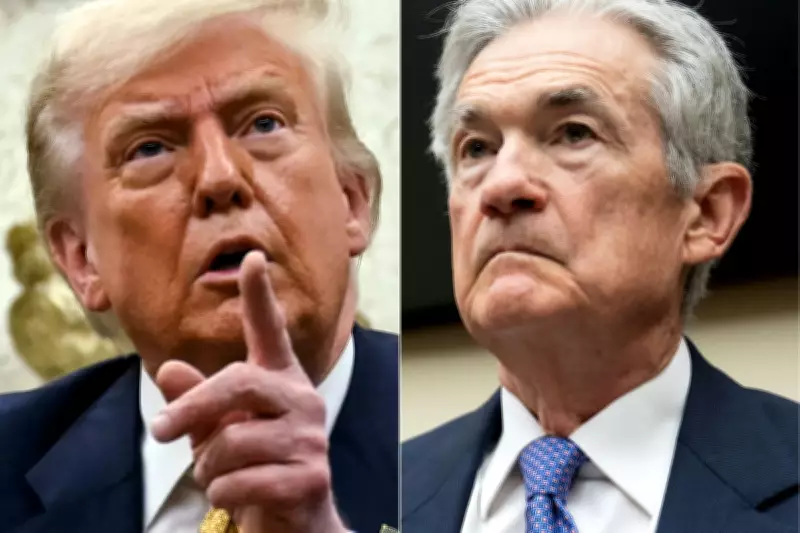
President Donald Trump has launched a fresh verbal assault on Federal Reserve Chair Jerome Powell, demanding the central bank implement what he calls "the lowest interest rate of any country in the world" while accusing the veteran economist of damaging national security.
Social Media Outburst Targets Fed Independence
In a Thursday post on his Truth Social platform, Trump complained that Powell had "again refused to cut interest rates" following the Federal Open Market Committee's decision to maintain current levels. The president claimed the bank has "absolutely no reason to keep them so high" and escalated his rhetoric by labeling Powell a "moron" who is "costing America Hundreds of Billions of Dollar a year in totally unnecessary and uncalled for INTEREST EXPENSE."
Tariff Revenue Argument Questioned
Trump's latest intervention attempts to connect his controversial tariff policies with monetary policy, arguing that "because of the vast amounts of money flowing into our Country because of Tariffs, we should be paying the LOWEST INTEREST RATE OF ANY COUNTRY IN THE WORLD." This assertion overlooks the economic reality that tariffs represent import taxes paid primarily by American consumers and businesses rather than foreign nations.

The president provided no explanation for how tariff revenue relates to the Fed's overnight rate, which determines short-term interbank lending costs. Nonetheless, he repeated his demand for the central bank to "substantially lower interest rates, NOW" while claiming his tariff policies have "made America strong and powerful again, far stronger and more powerful than any other Nation."
Fed Committee Votes to Hold Rates Steady
Trump's social media outburst came approximately eighteen hours after the Federal Open Market Committee voted ten to two to maintain current interest rates. This decision followed three consecutive months of rate reductions, with only two Trump appointees to the board supporting further cuts aligned with presidential demands.
In their official statement, the committee noted that "economic activity has been expanding at a solid pace" while declining to commit to future reductions. The Fed emphasized that "the extent and timing of additional adjustments" would depend on ongoing review of economic data and the broader outlook for the United States economy.
Inflation Concerns and Job Market Stability
The central bank's announcement highlighted that inflation "remains somewhat elevated" despite recent signs of stabilization in the job market. This cautious assessment reflects the Fed's traditional data-driven approach to monetary policy, which contrasts sharply with Trump's political demands for aggressive rate cuts regardless of economic indicators.
DOJ Investigation Adds Political Pressure
The Federal Reserve's announcement represents the first major policy decision since Powell confirmed the Department of Justice had launched an investigation into him. In an extraordinary video statement, the Fed chair characterized the probe as part of Trump's campaign to pressure the central bank into implementing unnecessary interest rate reductions to artificially stimulate economic growth.
"The threat of criminal charges is a consequence of the Federal Reserve setting interest rates based on our best assessment of what will serve the public, rather than following the preferences of the President," Powell stated in his social media address.
Bipartisan Congressional Concern Emerges
News of the Justice Department investigation has drawn criticism from both political parties in Congress, including Republican senators who have expressed alarm about potential interference with central bank independence. North Carolina Senator Thom Tillis has vowed to block any future Trump nominees to the Federal Reserve board until the matter receives proper resolution, signaling growing unease about the administration's approach to monetary policy institutions.
This latest confrontation occurs as the Supreme Court prepares to review the legality of Trump's tariff policies, which were implemented using emergency powers that critics argue exceed presidential authority. The court's decision could potentially invalidate nearly all tariffs imposed during Trump's administration, further complicating his attempts to link trade policy with monetary decisions.






