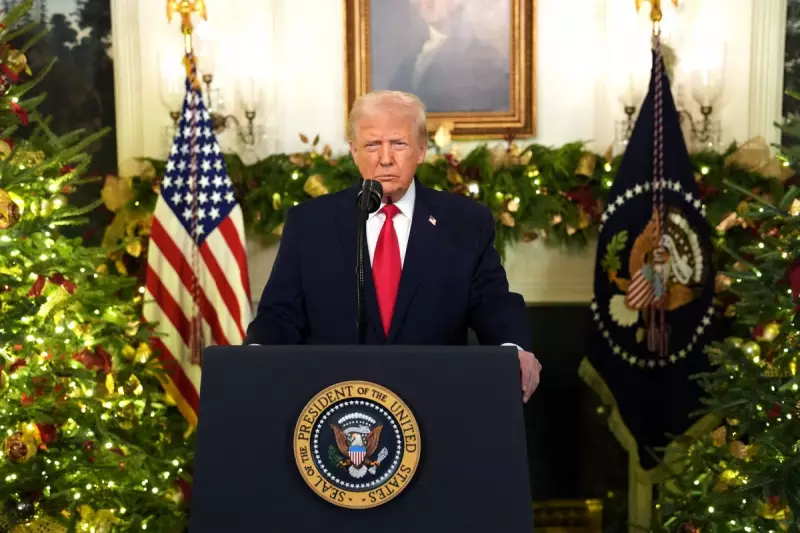
In an unconventional move, President Donald Trump delivered a nationally-televised speech on Wednesday, 17 December 2025, that closely resembled one of his signature campaign rallies, using the platform to place blame for the nation's economic challenges squarely on his predecessor.
A Campaign Rant from the Diplomatic Room
Speaking from the White House's Diplomatic Reception Room, Trump opened by asserting he had "inherited a mess" from the administration of Joe Biden, which he was now fixing. The address, requested by the White House and carried live by major networks, quickly devolved into a partisan catalogue of grievances.
Shouting into his microphone, the President made a series of boasts and claims with scant detail on future policy. He falsely stated inflation was "the worst in 48 years" when he took office a year prior. He then pivoted to praising his own administration's efforts on immigration and transgender rights, claiming to have brought "more positive change to Washington than any administration in American history."

Trump accused the previous government of being ruled by politicians who fought for "insiders, illegal aliens, career criminals... and above all foreign nations." In contrast, he positioned himself as the champion of "law abiding, hard working people." On the pressing issue of inflation, he claimed it had "stopped" after eleven months of his presidency, declaring "wages are up, prices are down."
Voters Remain Unconvinced Amid Economic Data
This televised address forms part of a broader push by Trump and his team to reshape the narrative on the economy. With midterm elections looming in 2026, his approval ratings are under pressure. Last week, he launched a series of rally-style appearances, starting in Mount Pocono, Pennsylvania, where he again labelled the "affordability" focus a Democratic "hoax."
However, recent polling suggests the public is not persuaded. A National Public Radio / Marist College survey released this week found that 57% of respondents disapprove of Trump's economic management, compared to 36% who approve. This marks his lowest rating on the economy across both his terms.
Critically, 68% of independents disapprove of his handling of the issue. His overall approval rating has sunk to 38%, a low not seen since the end of his first term in 2021.
The economic picture appears to support public scepticism. The latest report from the Bureau of Labor Statistics showed the national unemployment rate climbing to 4.6% in November, its highest level since 2021. While 64,000 jobs were added last month, the report revised away 105,000 positions from October and a further 33,000 from August and September.
The Reality of the Affordability Crisis
The NPR/Marist poll painted a stark picture of the affordability crisis Trump claims is a hoax. 70% of respondents said the cost of living in their area is not affordable, a view shared by nearly half of Republican voters. This represents a 25-point drop in perceived affordability since June.
Furthermore, roughly one in three Americans said their personal finances worsened in 2025, with a similar proportion expecting further deterioration next year. A majority, 52%, believe the US is currently in a recession.
Analysts point to significant headwinds, including the lingering impact of high interest rates and profound uncertainty surrounding President Trump's double-digit tariffs on imports. Businesses are reportedly hesitant to hire, focusing instead on retaining existing staff and adapting to unpredictable trade policies.
President Trump is scheduled to continue his promotional tour with a rally in North Carolina on Friday, 19 December, before departing for Mar-a-Lago. The data, however, indicates he faces a steep challenge in convincing a weary electorate of an economic turnaround that they are not feeling in their daily lives.