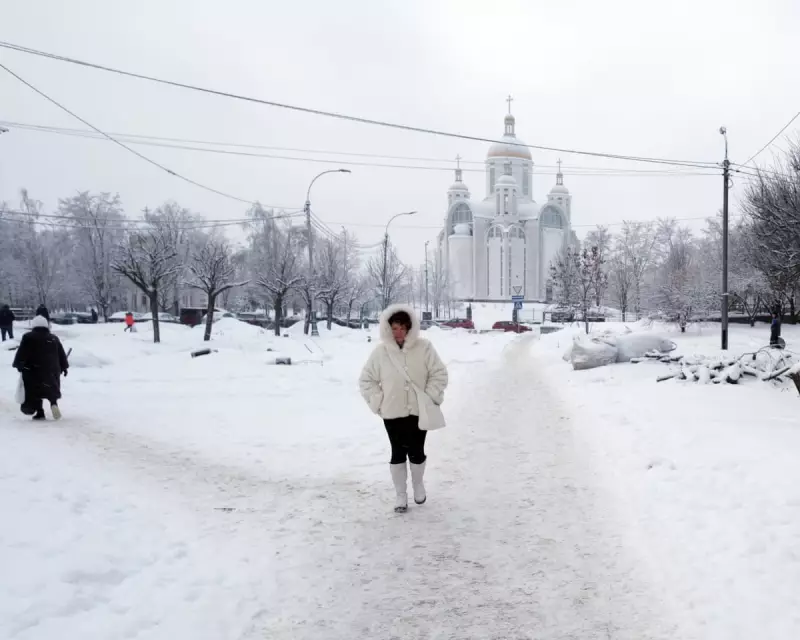
The Ukrainian city of Bucha, a symbol of resistance and wartime atrocity, now faces a new and chilling battle: surviving an extreme cold snap plunged into darkness by relentless Russian strikes on the nation's power grid.
A City Frozen in the Dark
As temperatures plummeted to nearly -20C, Russia launched a major assault on Ukraine's energy infrastructure on 9 January, exacerbating a national emergency. In Bucha, traffic lights stand dark, residential blocks are unlit, and a harsh silence has fallen, broken only by the biting wind and the sputter of emergency generators.
Outside the city's main water pumping station, three engineers, their faces reddened by the -12C cold and blowing snow, desperately work on a frozen generator. They wield a heat gun against the icy filter, a race to maintain the water supply. Mayor Anatolii Fedoruk watches on, his own office generator also frozen solid. "He apologises for the lack of coffee," a visitor noted.

Daily Life Amid Rolling Blackouts
The scheduled power rationing of three hours on and six off has become unmanageable. In the Battkava cafe, owner Oleksandr Bartkov, 28, waits for his generator to warm before he can serve the first espresso. "Recently, in the eight or nine hours we are usually open, we have three to four hours of electricity," he explains. The 9 January attack left the city with a full day without any power, pushing small businesses to the brink. "A lot have closed. I think more will shut," Bartkov predicts.
Mayor Fedoruk acknowledges the severity but points to a grim comparison. His own children, living in a high-rise in Kyiv, have asked to stay with him due to the blackouts. He highlights a critical vulnerability: much of Ukraine's Soviet-era power grid, whose locations are well-known to Moscow, is concentrated in large, easily targetable plants.
‘An Attempt to Break People’
Experts describe Russia's strategy as a deliberate weaponisation of winter. Oleksandr Kharchenko, director of the Energy Industry Research Center in Kyiv, stated this is "an attempt to break people," aimed at turning "a man-made disaster into an absolute crisis." Ukraine's security service, the SBU, has labelled the sustained attacks on power and heating plants as "crimes against humanity."
The human cost is visceral in temporary housing for displaced families. Manager Vitalina Tsisar, 31, described the panic when a raid on 13 January cut power at 1 am. "Within two hours it was freezing cold... It got down to 6C," she said. Residents huddled with their children in coats and hats, the single working radiator from a faltering generator offering scant relief. In the kitchen, Tetiana Kharkivska served stew to her seven-year-old son, Roman, who admitted, "I wasn't scared. But I was really cold."
The crisis has sparked political tensions, with President Volodymyr Zelenskyy criticising Kyiv's municipal authorities for inadequate preparedness as he declared a state of emergency.
Yet, in Bucha, a city that has already endured the worst of war, defiance persists. Reflecting on the early days of the invasion, Mayor Fedoruk draws a parallel to the current struggle: "Four years ago, Russia said it would take Kyiv in three days and failed... They prepared to exhaust us. But we're standing. We are still defending."