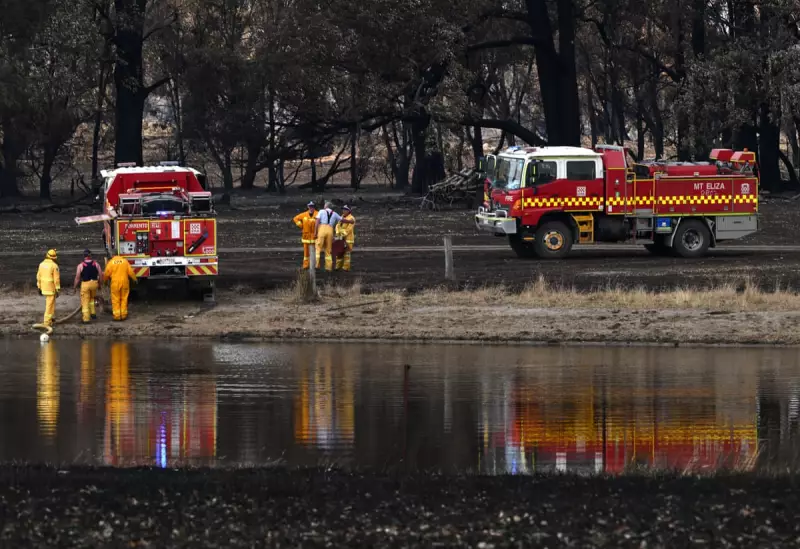
As bushfires continue to ravage communities in central Victoria, a fierce political battle over the funding of the state's Country Fire Authority (CFA) has intensified. The opposition and firefighters' unions have accused the Labor government of cutting resources for the vital volunteer-based service, while Premier Jacinta Allan has denounced these claims as "misinformation and conspiracy theories." The release of the CFA's long-delayed annual report has now thrown crucial data into the heated debate.
What the CFA's Annual Report Reveals
The CFA's 2024-25 annual report, tabled in parliament almost three months late, shows the service received $361.3 million in government grants. This figure represents the highest level of funding in five years, marking an increase of $21.8 million from the previous financial year. The government maintains that annual budgets naturally fluctuate based on assessed fire risk.
The report also indicates the CFA's total income rose by $26.4 million to $477.4 million, and its asset base grew from $2.12 billion to $2.23 billion. However, it recorded an operating deficit of $50.5 million. While this is an improvement on the previous year's $75.5 million deficit, it contrasts sharply with the $357.7 million surplus seen in 2022-23.

In his foreword, CFA chief executive Greg Leach emphasised the ongoing focus on achieving "financial sustainability" and providing essential fleet and assets for volunteers. It is important to note that these figures do not include additional emergency funding provided by the government in November following a severe seasonal bushfire outlook, which will appear in next year's accounts.
Volunteer Numbers and a Delayed Release
Beyond finances, the report highlights ongoing challenges in volunteer recruitment and retention. Despite significant efforts, there was a slight dip in operational volunteers to 28,753 in 2024-25, down from 28,906 the previous year. The CFA has a target of 35,000-37,400 operational volunteers. Chief Officer Jason Heffernan acknowledged the "ageing volunteer profile" but noted a recent recruitment drive attracted strong interest from younger demographics.
The report's late submission to parliament became a controversy in itself. Premier Allan initially blamed the Victorian Auditor-General's Office (VAGO) for the delay, but VAGO issued a rare public statement rejecting this, confirming it approved the report on 11 November. Emergency Services Minister Vicki Ward stated she received the report on 18 December and tabled it earlier than planned due to the public funding dispute.
A Dispute Far From Extinguished
The report's publication has done little to douse the political flames. Minister Ward stated it proves the CFA is "stronger, better funded and better resourced under a Labor government," again accusing the opposition of "fear-mongering."
However, the opposition and industry bodies remain unconvinced. The opposition's emergency services spokesperson, Danny O'Brien, argues that when adjusted for inflation, the funding actually represents a $55 million cut since 2020. Meanwhile, United Firefighters Union secretary Peter Marshall contends that even with increased funding, years of neglect have left the CFA with an ageing fleet, citing 800 outdated tankers.
Stephen McDonald from Volunteer Fire Brigades Victoria echoed concerns, stating the fleet issue is "one part – albeit a highly visible part, of a much bigger problem." He called for a non-partisan, long-term investment plan covering equipment, facilities, and support systems for all volunteer-based emergency services. As the bushfire threat persists, the debate over adequately resourcing those on the front lines shows no sign of abating.