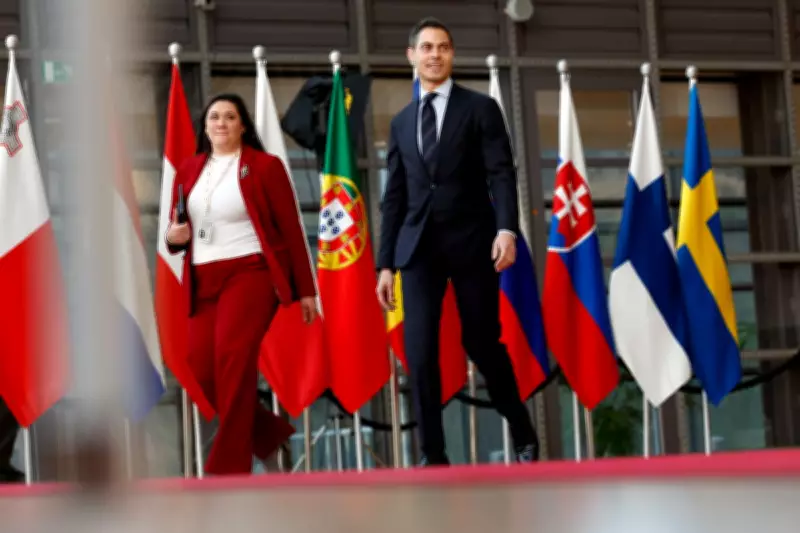
European Union leaders are convening an emergency summit on Thursday to confront the escalating energy crisis triggered by the ongoing war in the Middle East. The conflict, which spans critical energy-producing regions and vital shipping lanes, has driven oil and gas prices to alarming heights, threatening economic stability across the bloc.
Deflecting Military Entreaties Amid Rising Tensions
Many EU leaders have resisted calls from U.S. President Donald Trump to deploy military assets to secure the Strait of Hormuz, a crucial global chokepoint for oil, gas, and fertilizer shipments. Instead, the focus has shifted to domestic economic pressures, with soaring energy costs and fears of a new refugee influx from the Middle East pushing the issue to the top of the summit agenda.
Belgian Prime Minister Sounds Alarm on Structural Risks
Belgian Prime Minister Bart De Wever expressed grave concerns ahead of the European Council meeting, which brings together the 27 leaders of EU nations. "We are very worried about the energy crisis," he stated, noting that prices were already elevated before the conflict but have since spiked dramatically due to the war.

"If that becomes structural, we’re in deep trouble," De Wever warned. "At a European level, some measures can be taken to address the problem of the high energy prices." His remarks underscore the urgency of finding collective solutions to mitigate the economic shocks rippling through diverse markets from Romania to Ireland.
European Commission Proposes Financial Instruments
The European Commission has presented leaders with a suite of financial instruments that member states could potentially deploy to lower energy prices, with these options slated for detailed discussion. However, officials acknowledge that no single policy is likely to fully blunt the war's economic impact across the bloc's fragmented energy markets.
Diplomatic Stance on Iran and Lebanon Conflict
EU leaders have faced challenges in adopting a unified stance on the fighting in Iran and Lebanon. While critical of the Iranian government, they have refrained from providing military support, opting instead for diplomatic and economic measures.
Dutch Prime Minister Rob Jetten articulated this position, stating, "This is a war that was started by the United States and Israel against Iran on reasons that I can understand because the Iranian regime is brutal not only for its own people, but also for the broader region and a security threat for Europe."
He added, "But it’s not a war that we are part of," calling for enhanced sanctions on Iran and support for opposition groups as alternative strategies. This reflects the EU's broader struggle to balance security concerns with economic imperatives amid the volatile Middle East landscape.