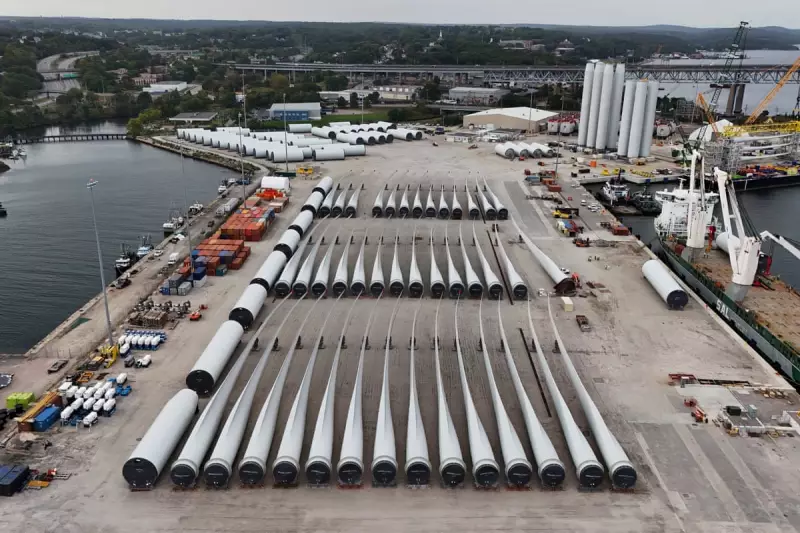
The Trump administration has delivered a severe blow to the US renewable energy sector, ordering an immediate pause on all leases for offshore wind farms currently under construction. The move, justified by the Department of the Interior on grounds of "national security risks", directly impacts five major projects along the country's east coast.
Projects Grounded Amid Security Concerns
Secretary of the Interior, Doug Burgum, announced the decision, stating the government's prime duty is to protect the American people. He cited emerging risks from adversary technologies and vulnerabilities created by large-scale projects near populous coastal areas. The specific concern raised is that wind turbine towers could create radar interference or "clutter", potentially hampering US military operations.
The halt affects some of the most significant renewable energy developments in the nation:

- Vineyard Wind 1 off Massachusetts.
- Sunrise Wind and Empire Wind in New York.
- Revolution Wind off Rhode Island.
- Coastal Virginia Offshore Wind.
All these projects had previously been reviewed and approved under President Joe Biden's administration, which found no undue national security threats. Democrats have highlighted two Pentagon assessments of the Revolution Wind project that concluded it "would not have adverse impacts to DoD missions in the area".
Economic and Energy Consequences
The decision has sparked alarm among wind developers and regional grid operators. They warn the move will jeopardise billions of dollars in investment and thousands of jobs. Furthermore, it blocks a crucial new supply of clean electricity needed to support power grids facing surging demand, partly driven by the rapid advance of artificial intelligence.
This action represents an escalation in a long-running battle. Earlier in December, Trump labelled wind energy "the worst" and a "scam" at a Pennsylvania rally, repeating aesthetic objections he has held since his time at a Scottish golf course over a decade ago. This stance contradicts market reality, as wind is now among the cheapest energy sources, with costs having fallen sharply in recent years.
Legal Challenges and Industry Backlash
The administration's approach has already faced legal setbacks. Earlier this month, a federal judge in Massachusetts ruled that a broader Trump order to ban wind project permits was "arbitrary and capricious and contrary to law", striking it down after a case brought by 17 states and Washington DC.
Clean-energy advocates view the latest halt as a significant setback for the US offshore wind industry, which already lags behind several European nations. Ted Kelly, lead counsel at the Environmental Defense Fund, criticised the administration for "recklessly obstructing the build-out of clean, affordable power" while propping up aging, polluting coal plants.
The immediate future of these five major projects now rests on a mitigation plan to be developed between the Interior and Defense departments, casting a shadow of uncertainty over America's renewable energy transition.