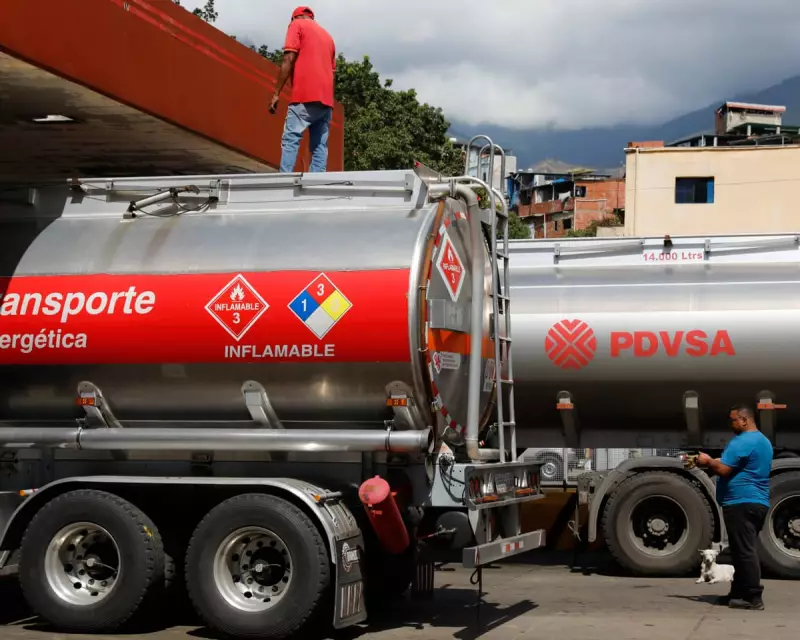
In a bold move that has sent shockwaves through global energy markets, the administration of Donald Trump has laid claim to billions of dollars' worth of Venezuelan crude oil. The White House announced this week that Venezuela would be "turning over" nearly $3bn (£2.3bn) of crude currently stranded in tankers and storage facilities, with the US planning to control the country's oil sales "indefinitely." This seizure is the opening gambit in a far more ambitious plan: to take control of Venezuela's vast reserves, which represent almost a fifth of the world's proven oil.
The Daunting Price of Revival
While the initial cargo grab may seem like a swift victory, experts warn it could be the last easy win for the president. The monumental task of reviving Venezuela's crippled oil industry presents a web of financial and logistical nightmares. Venezuela, a founding Opec member, once pumped 3.5 million barrels per day in the late 1990s. Today, after decades of neglect and alleged corruption, its state-run industry produces less than 1 million barrels daily—under 1% of the global market.
According to analysis by Rystad Energy, the total spending needed to return Venezuela's output to 2 million barrels a day could soar to $183bn, with the process potentially dragging on until 2040. This colossal sum covers the cost of repairing and upgrading the country's decrepit infrastructure, owned by state firm PDVSA, and the expensive process of extracting its dense, heavy crude.

"In order to make the scenario a possibility, at least 25% of this amount – $30bn-$35bn – would have to be committed in the first two years," Rystad stated. This level of investment would likely require international oil companies, who will only commit funds if they have "full confidence in the stability of the country’s systems and its investment climate."
Investor Jitters and a Crowded Market
US officials have begun talks with oil executives, but the discussions are fraught. Companies are reportedly demanding significant guarantees to protect multibillion-dollar investments. Under intense shareholder pressure to maintain capital discipline, firms are highly selective, only backing projects that promise strong returns.
The economics are challenging. While the break-even price for Venezuelan crude from the Orinoco region was estimated at $49 a barrel in 2020, lack of investment may have pushed it to $65-$80. This must compete with projects worldwide. "Any capex committed towards Venezuelan oil would have to compete with the potential return on other projects," noted David Oxley of Capital Economics.
Compounding this is a global supply glut that is depressing prices. Goldman Sachs had already predicted the average price of Brent crude would fall from $69 in 2025 to $56 this year. Success in boosting Venezuelan output could push it to $54.
The Stranded Asset Risk in a Green Transition
Perhaps the most profound long-term risk is that Trump's gamble becomes a "scramble for stranded assets." With the rise of renewable energy and electric vehicles, the International Energy Agency predicts global oil demand could peak around 2030. If Venezuela's production only reaches full capacity by 2040, massive investments could be seriously undermined.
Research by Carbon Tracker warns that the falling cost of renewables makes Venezuela's heavy crude increasingly unviable. "The tragedy is that we’re fighting over barrels that look huge on spreadsheets but shrink rapidly when confronted with physics, economics and time," said Guy Prince of the thinktank.
Furthermore, the intervention's most significant impact may be indirect: "distracting from the urgent transition to renewables; reinforcing a 20th-century paradigm of resource conflict... potentially creating regional instability that hinders coordinated climate policy."
Political Instability and Cautious Giants
Trump has touted transformative investment from America's oil majors, but these giants are wary. The region's history of political instability and popular opposition to foreign interference, coupled with the unpredictability of US policy itself, gives them pause. "No one wants to go in there when a random fucking tweet can change the entire foreign policy of the country," one private equity investor told the Financial Times.

History offers cautionary tales. In Iraq, production took nearly a decade to return to pre-2003 invasion levels. Libya's output collapsed after 2011 and has still not fully recovered. The largest companies' risk aversion means the first beneficiaries of Trump's plan are likely to be service firms and smaller "wildcat" drillers with higher risk tolerance.
"First movers with a higher risk tolerance are likely to capture the greatest upside," said analyst Carlos Bellorin. "Smaller US independents are best positioned... securing one or two world-class Venezuelan assets could be genuinely transformational."
Ultimately, while the prize of Venezuela's "tremendous wealth" is alluring, the path to unlocking it is mined with financial pitfalls, market headwinds, and profound geopolitical and environmental uncertainties. The Trump administration's high-stakes South American gamble is only just beginning, and the odds are steep.