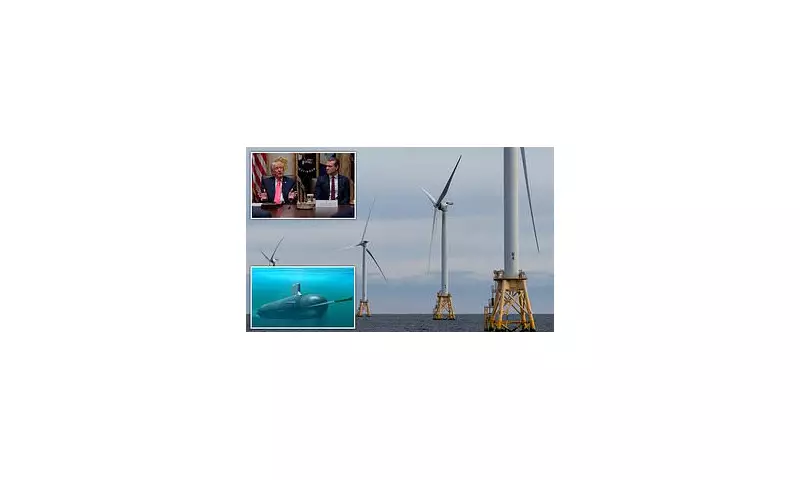
In a dramatic policy shift, the United States Interior Department has ordered an immediate pause on five major offshore wind energy projects. The decision follows urgent warnings from defence officials about serious national security risks identified in newly completed classified reports.
Security Concerns Ground Wind Energy Expansion
The sudden move, enacted on Monday, directly impacts the Revolution Wind, Vineyard Wind 1, Sunrise Wind, CVOW, and Empire Wind lease areas. US Interior Secretary Doug Burgum strongly defended the action, stating the government's 'prime duty... is to protect the American people.'
The department clarified that the pause will allow government agencies 'time to work with leaseholders and state partners' to see if the identified threats can be mitigated. Secretary Burgum cited 'national security risks' and 'relevant adversary technologies' associated with large-scale offshore wind, though specific details were not publicly disclosed.
Experts Warn of Defence System 'Blackout'
The intervention comes as security analysts raise the alarm that the massive spinning turbines could create a 'blackout' for crucial US defence systems. Diana Furchtgott-Roth, a senior official from the Reagan, Trump, and both Bush administrations, explained the core issue to the Daily Mail: 'The point is that these wind turbines interfere with radar.'
Furchtgott-Roth, now Director of the Center for Energy, Climate and Environment, warned the disruption is wide-ranging, affecting:
- Early warning systems for ballistic missiles
- Aviation safety and tracking
- Accurate weather prediction models
- Maritime and ocean surveillance
She cautioned that radar cannot distinguish between plane types, leaving airspace vulnerable. More ominously, she stated that interference with early-warning systems could prolong response times to an attack, potentially enabling a sneak assault.
Underwater Threats and Economic Debate
The risks are not limited to the skies. Furchtgott-Roth revealed that turbines emit vibrations, electromagnetic fields, and acoustic signals that travel vast distances underwater. These emissions could mask the sound of enemy submarines, degrading the navy's ability to detect underwater threats.
The decision also reignites the debate over wind power's economics. Furchtgott-Roth argues it makes electricity more expensive by necessitating a dual system: the wind farm itself and a backup natural gas plant for calm periods. She likened it to having a 'free' car you can only drive during the day. Other energy experts contest this, pointing to existing grid backup capacity and reduced fuel costs when wind is generating.
'We live in a dangerous environment,' Furchtgott-Roth concluded. 'Any energy projects that interfere with our national defense system should not be permitted to go forward.' The Pentagon has not yet commented on the reports or the Interior Department's decisive action.