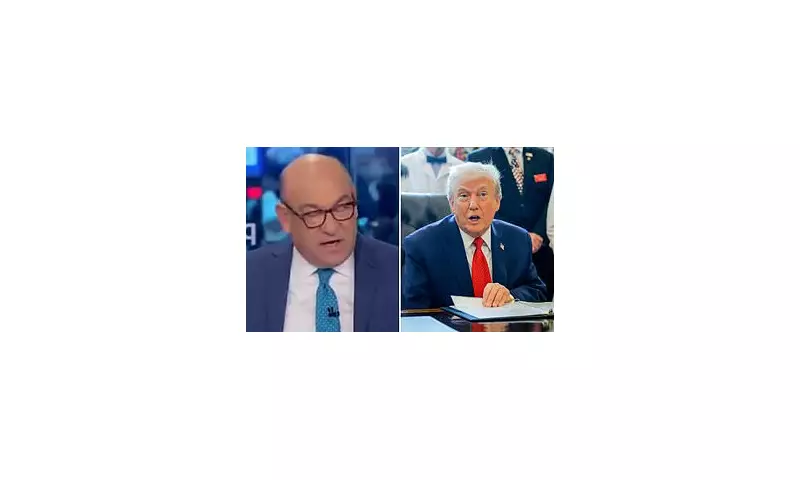
In a live television moment that captured the economic surprise of the day, CNBC's veteran economics correspondent Steve Liesman was left momentarily speechless as he delivered better-than-expected US inflation figures. The data, released on Thursday, appeared to contradict his earlier stark warnings about the impact of President Donald Trump's tariff agenda.
A Moment of Live-Air Shock
Reporting on the Consumer Price Index (CPI) for CNBC's Squawk Box, Liesman introduced the crucial number of the morning. What followed was a palpable pause and a look of sheer surprise spreading across his face. The CPI showed inflation had risen by 2.7 percent year-on-year in November, a notable drop from the 3 percent increase recorded in September.
"Oh," Liesman uttered, before collecting himself. "Maybe coming in a little better than expected," he added, after another brief hesitation. He went on to describe the figure as "a very good number," specifically highlighting the core rate, which excludes volatile food and energy prices, at 2.6 percent.

From 'Insane' Policy to 'Very Good' Numbers
The reaction was particularly striking given Liesman's forceful commentary earlier in the year. In March, just two months after Trump's return to office, the reporter had issued a stark on-air warning. He labelled the President's tariff agenda "insane" and "absolutely insane," stating there was no other way to describe it. A month later, he infamously compared the policy to "steering the Titanic towards the iceberg."
Yet, faced with the November data, Liesman conceded: "I'm not calling I'm just reading the headlines here... That is a very good number here." He noted the "very, very low monthly rate" but cautioned he had yet to analyse the internal details of the report.
Market Joy and Statistical Caution
The positive surprise sent Wall Street's main indexes higher on Thursday, buoyed by renewed expectations that the Federal Reserve might consider interest rate cuts. The White House was quick to celebrate, with Trump's top economic adviser calling it "an astonishingly good" report.
However, economists urged caution. They pointed out that the 43-day federal government shutdown had delayed data collection until the second half of November, a period coinciding with heavy holiday discounting by retailers. This disruption meant the Bureau of Labor Statistics could not publish reliable month-to-month changes, leading some to dub it a "Swiss-cheese" report with significant gaps.
Despite the overall dip, the data revealed ongoing pressures in specific sectors linked to trade policies. Beef prices surged by 15.8 percent year-on-year, the largest jump since June 2020, while coffee prices rocketed by 18.8 percent. Although Trump has since rolled back duties on some goods, including beef and coffee, economists warn consumers may not see lower prices immediately.
The report sets the stage for the ongoing political battle over the cost of living, which will be a central issue as Republicans fight to retain control of the US Congress in 2026. The latest figures stand in stark contrast to the peak of inflation under former President Joe Biden, when the CPI hit a four-decade high of 9 percent in June 2022.