EU Commission Proposes 'Buy EU' Strategy to Bolster Domestic Industries
The European Commission has unveiled a groundbreaking "Buy EU" plan designed to strengthen domestic low-carbon industries and enhance the continent's competitiveness against China. This initiative, formalized as the Industrial Accelerator Act, represents a significant departure from Brussels' traditional advocacy for open markets, signaling a new era in European economic policy.
A Shift in Doctrine and Strategic Autonomy
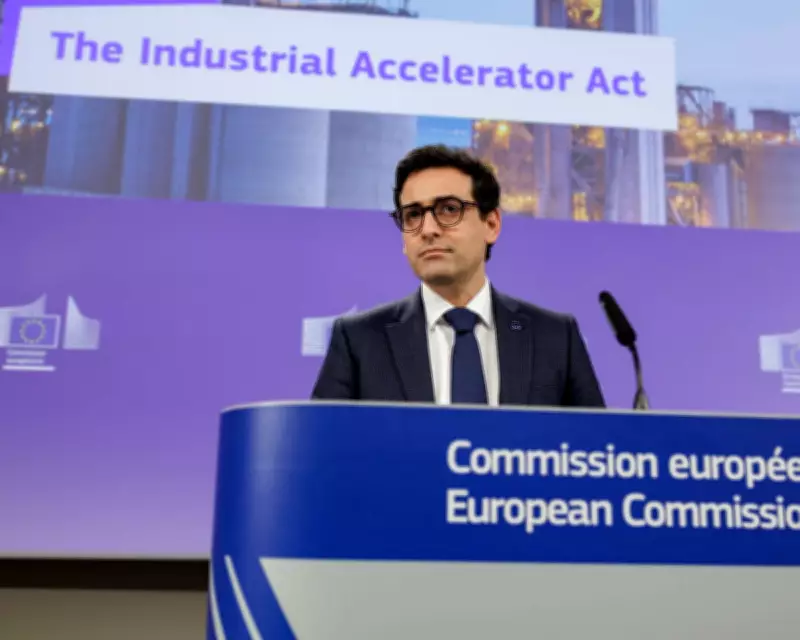
Speaking at a press conference in Brussels, EU Commission Vice President Stéphane Séjourné described the act as "a change in doctrine" that would have been "unthinkable just a few months ago." He emphasized that without a robust industrial base and a European social model, achieving climate transition and strategic autonomy would be impossible. Séjourné highlighted recent turmoil in the Middle East, such as events in Iran, as a catalyst for this plan, underscoring the urgency of shoring up European industry amidst global instability.
The plan is inspired by French government ideas and responds to intense competition from Beijing, which has led to Europe losing its once-thriving solar panel industry to China. Séjourné warned, "If we do nothing then it's quite clear that very soon 100% of tech technology will be produced in China." Currently, about 50% of batteries and 94% of solar photovoltaic modules and cells used in the EU are imported from China, illustrating the scale of the challenge.

Key Provisions and Targets
The Industrial Accelerator Act sets ambitious targets to reverse Europe's industrial decline. It aims to increase manufacturing's share of Europe's GDP from 14.3% in 2024 to 20% by 2035. To achieve this, local and national authorities will be required to meet "Made in the EU" content targets when spending public money or designing subsidy programmes for strategic sectors, including green tech and automotive industries.
- At least 70% of components for electric cars, excluding batteries, must be made in the EU when purchased by governments or benefiting from public funds.
- Authorities must prioritize buying more expensive low-carbon steel, aluminium, and cement to promote sustainable practices.
- Foreign firms investing in key sectors, such as clean tech, with investments of €100 million or more, must ensure at least 50% of jobs go to EU workers, alongside conditions on ownership, innovation, and research.
The commission estimates this plan could create and preserve 150,000 jobs in clean tech and low-carbon sectors, providing a much-needed boost to the European economy.
Inclusion of Trading Partners and Reciprocity
Despite the focus on domestic production, EU officials have left the door open for including countries with close economic ties, such as the UK and Japan, if there is reciprocal market access. The draft regulation states that countries with free-trade agreements or customs unions with the EU, like Norway, Iceland, and Turkey, could be considered local producers. Similarly, 21 countries that have signed the WTO agreement on government procurement, including the UK and Canada, may benefit from this openness.
In contrast, countries with more closed markets, such as the US and India, are likely to face restrictions. Séjourné declined to specify "who's in, who's out," but promised a "reciprocity assessment" of the EU's trading partners in the coming months to ensure fair treatment.
Reactions and Concerns
The plans have sparked mixed reactions. Bas Eickhout, co-leader of Green MEPs, welcomed the move, stating, "Europe needs to leave behind a bit the naivety that we had. There is no global open market. Look at the US, look at China, look at all the big players; they are all doing industrial policies. It's about time Europe starts doing that as well."

However, trading partners like the UK, Japan, and Turkey have expressed alarm. UK Business Secretary Peter Kyle urged the EU to stop "putting up barriers" during a recent visit to Brussels. Additionally, the German Engineering Federation (VDMA), representing 3,000 small and medium-sized companies, warned that local content rules should be designed with restraint. Thilo Brodtmann, VDMA's chief executive, argued that focusing on local content distracts from Europe's real challenges, such as high administrative costs and a weakened internal market.
This proposal marks a cautious yet decisive step towards a more protectionist industrial policy in Europe, aiming to secure economic resilience and job preservation in an increasingly competitive global landscape.