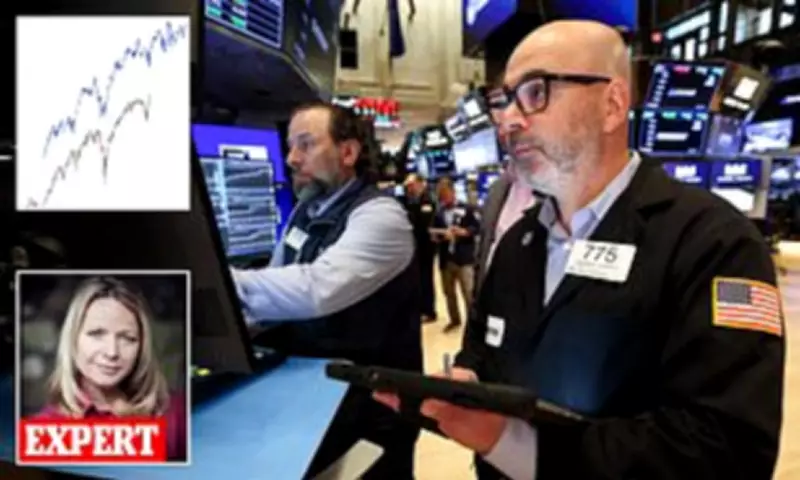
If you have spent any time exploring financial social media recently, you might have encountered a video graphic that is unsettling seasoned investors. It features two overlaid charts: one depicting the dot-com boom and bust of the S&P 500 in the late 1990s and early 2000s, and the other showing the S&P 500 from 2022 to today. In the video, the older chart aligns with the more recent one, revealing a two-and-a-half-year overlapping period where both appear virtually identical.
The eerie coincidence between the upward trends in these two charts strongly suggests what might follow the benchmark S&P 500 index's steep climb over the last 30 months. Recent gains have been driven by investor enthusiasm and rapid technological change, strangely parallel to the dot-com boom more than two decades ago. The suggestive chart overlay implies that today's market could end in a crash akin to the dot-com bust seen on the older chart.
Parallels to the Dot-Com Era
It is a familiar pattern for stock markets: a transformative technology capturing the imagination of investors, driving extraordinary gains over a relatively short period. During the late 1990s, it was the internet. Today, the rally is powered largely by artificial intelligence. According to eToro US investment analyst Bret Kenwell, there are 'clear parallels' between the two eras. In both cases, markets have rallied around innovations with the potential to reshape the global economy. That optimism has translated into strong upward momentum for equities, particularly within the technology sector.

Key Differences
However, Kenwell points to a key difference: Unlike many high-flying companies of the dot-com era, today's market leaders are not built purely on speculation. Instead, many are supported by robust earnings, significant revenue streams, and tangible demand tied to enterprise adoption and infrastructure investment. 'We do not hear the term 'bubble' nearly as often today in connection with the AI trade,' Kenwell notes, adding that investors are placing greater emphasis on fiscal discipline and profitability, especially among mega-cap technology firms. That said, he cautions that risks remain. While the current rally is underpinned by 'real customers and measurable adoption,' this does not eliminate the possibility of pockets of market euphoria or longer-term bubble dynamics emerging.
Cautious Perspectives
Echoing this cautious perspective, financial expert and former BBC business anchor Susannah Streeter told the Daily Mail that while historical comparisons are useful, they should not be taken as a precise roadmap. 'Past performance isn't a guide to the future,' she emphasized, noting that market corrections rarely follow identical patterns. Still, she admits that 'some of the parallels to the frenzy of speculation 25 years ago can't be ignored.' Concerns about an AI-driven bubble have continued to swirl as Wall Street reaches fresh record highs. Rising valuations, coupled with intense enthusiasm for artificial intelligence breakthroughs, have drawn inevitable comparisons to the speculative frenzy of the late 1990s.
Lessons from History
During the peak of the dot-com boom, Streeter highlights that investors poured capital into hundreds of internet-based companies, many of which had little more than ambitious business plans. Low interest rates and a surge of excitement around the digital economy created a perfect environment for rapid expansion and, ultimately, excess. When monetary conditions tightened and funding dried up, the bubble burst dramatically. 'The big bust when it came shattered confidence and rocked the foundations of the online world, as irrational exuberance blew up in investors' faces,' she said. 'Failures littered the tech landscape including online shopping companies Webvan.com, Pets.com and Boo.com, communications firm WorldCom and content network Broadland Sports.'

Even survivors saw their share prices battered, and Streeter points to Amazon as a 'striking example.' Its shares soared during the boom, only to fall by around 90 per cent when the bubble burst. Yet over the longer term, the company not only recovered but evolved into one of the world's most dominant technology giants, a reminder that innovation-driven markets can produce both spectacular failures and extraordinary success stories. This duality remains central to today's AI narrative. While some companies may ultimately fail to live up to the hype, others could emerge as foundational players in the next phase of technological evolution. 'Not all tech companies are created equally,' she said.