

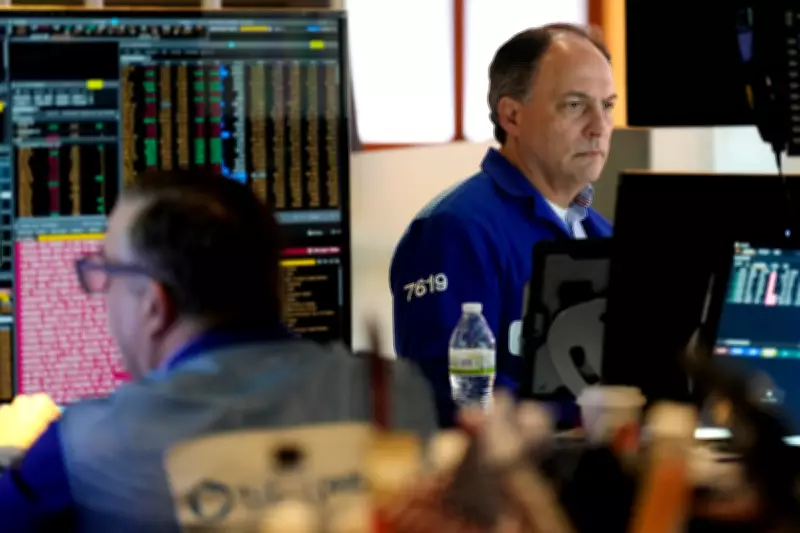
Asian Markets Decline Amid Wall Street Tech Sell-Off Triggered by AI Disruption Fears
Asian shares were predominantly lower on Friday, closely tracking significant losses on Wall Street as a widespread sell-off of technology-related stocks took hold. Investors are increasingly anxious about the potential for artificial intelligence disruptions to undermine traditional business models, leading to sharp declines in key markets across the region. U.S. futures remained mostly unchanged, indicating ongoing uncertainty in global financial sentiment.
Regional Market Performance Highlights Diverging Trends
In Tokyo, the Nikkei 225 index fell by 0.8% to settle at 57,165.13, a notable retreat after it had surpassed the 58,000 mark for the first time early on Thursday. SoftBank Group, a major player with a strong focus on AI investments, plummeted by 6.8% despite reporting a quarterly profit on Thursday, bolstered by gains from its stakes in companies like OpenAI.
South Korea's Kospi provided a contrasting picture, rising by 0.4% to reach 5,545.49 after crossing the 5,500 threshold on Thursday. This gain was primarily driven by advances in technology-related stocks, with Samsung Electronics, the index's largest listed company, climbing by 1.2%.

Hong Kong's Hang Seng index dropped sharply by 1.8% to 26,547.97, while the Shanghai Composite index in China declined by 0.7% to 4,105.04. In Australia, the S&P/ASX 200 traded 1.4% lower at 8,919.30, reflecting the broader regional downturn.
Wall Street's Tech Rout Sets the Stage for Global Concerns
On Thursday, Wall Street experienced substantial losses as AI-related worries dampened investor sentiment. The S&P 500 fell by 1.6%, or 108.71 points, to 6,832.76, marking its second-worst day since Thanksgiving, although it remains near an all-time high set last month. The Dow Jones Industrial Average decreased by 1.3%, or 669.42 points, to 49,451.98, and the Nasdaq composite lost 2%, or 469.32 points, to 22,597.15.
Notable individual stock movements included American technology giant Cisco Systems, which sank by 12.3% despite reporting better-than-expected quarterly results, as investors fretted over its ongoing profitability. Similarly, shares of technology company AppLovin plunged by 19.7% even with stronger quarterly profits, weighed down by fears that AI could undercut its core business operations.
Analyst Perspectives on AI Disruption Risks and Market Outlook
Fears of AI disruptions across various industries have significantly eroded investor confidence in recent days, particularly affecting software stocks. Some analysts warn that uncertainties surrounding AI disruption risks are likely to persist for an extended period, with many remaining concerned about whether massive corporate investments in AI will ultimately yield returns.
However, other analysts maintain a more optimistic stance. Economists at Capital Economics, for instance, argue that they still believe in the AI rally and predict that this year will be a good year for the S&P 500, building on technology-led gains. Thomas Mathews, head of markets for Asia Pacific at Capital Economics, noted in a recent analysis, Our sense remains that a sustained reversal of tech outperformance would require a big slide in tech itself. We think tech will fare very well.
In other U.S. stock movements, McDonald's rose by 2.7% following stronger-than-expected profits, and Walmart gained 3.8%, highlighting some resilience in non-tech sectors.
Broader Economic Indicators and Commodity Market Movements
Investors and economists are also closely monitoring upcoming U.S. inflation data scheduled for release on Friday, which could influence the Federal Reserve's decisions on interest rate adjustments. Some economists anticipate that the likelihood of another rate cut is low over the next few months, adding another layer of complexity to market dynamics.
In early Friday dealings, U.S. benchmark crude oil edged down by 0.1% to $62.77 a barrel, while Brent crude, the international standard, fell less than 0.1% to $67.49 per barrel. Precious metals saw gains, with gold prices increasing by nearly 1% to $4,995.80 per ounce after earlier dipping below $5,000, and silver rising by 1.4% to $76.72 per ounce.

Currency markets showed modest movements, with the U.S. dollar strengthening to 152.89 Japanese yen from 152.72 yen, and the euro trading at $1.1867, down slightly from $1.1871.
This report includes contributions from AP Business Writer Stan Choe, underscoring the collaborative nature of financial journalism in capturing these market shifts.





