

Asian stock markets presented a mixed picture on Wednesday, 14 January 2026, following a retreat from record highs on Wall Street. The trading session unfolded against a backdrop of growing political uncertainty in several regions, notably Iran, which cast a shadow over investor sentiment globally.
Regional Market Performance: Gains and Losses
Performance across the Asia-Pacific region was divergent. Japan's Nikkei 225 index surged 1.6% to 54,413.92, buoyed by domestic political speculation. Reports suggested Prime Minister Sanae Takaichi might call a general election soon, adding to market activity. Takaichi had met with South Korean President Lee Jae Myung the previous day, with both leaders committing to collaborate on economic and security matters.
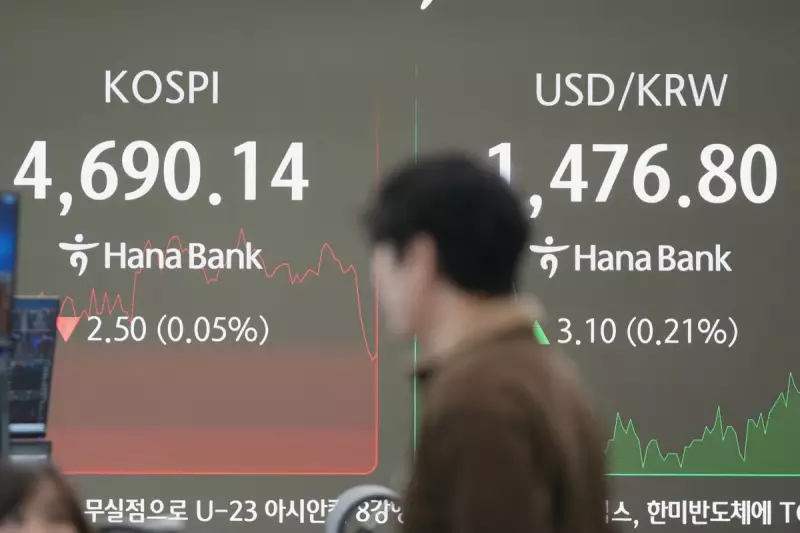
In contrast, South Korea's Kospi edged down 0.1% to 4,687.32. Australia's S&P/ASX 200 also slipped slightly, losing 0.1% to 8,798.80. Chinese markets showed strength, with the Shanghai Composite jumping 1.2% to 4,187.14 and Hong Kong's Hang Seng adding nearly 0.8% to 27,055.14.

Global Headwinds: Politics and Policy
Several geopolitical factors contributed to the cautious atmosphere. In Iran, activist groups reported the death toll from recent protests had surpassed 2,500 as of Wednesday. Concurrently, former US President Donald Trump announced a plan to impose a 25% tax on imports to the United States from nations that conduct business with Iran, a move threatening to escalate trade tensions.
On Wall Street, major indices stepped back from their recent peaks. The S&P 500 fell 0.2% from its all-time high, closing at 6,963.74. The Dow Jones Industrial Average experienced a more significant drop, falling 398.21 points (0.8%) to 49,191.99, while the Nasdaq composite dipped 0.1% to 23,709.87.
Corporate Earnings and Economic Signals
The pullback came as the corporate earnings season began with mixed results, putting pressure on companies to justify high stock valuations. Analysts polled by FactSet anticipate S&P 500 firms will report earnings per share growth of 8.3% for the final quarter of 2025.
JPMorgan Chase saw its stock fall 4.2% after reporting profit and revenue that missed analyst expectations. CEO Jamie Dimon remained relatively optimistic about the US economy, citing continued consumer spending and generally healthy businesses. Delta Air Lines shares lost 2.4% despite a profit beat, as its revenue and 2026 profit forecast disappointed.
On a positive note, several healthcare companies raised their financial forecasts. Moderna stock soared 17.1% after stating its 2025 revenue would likely exceed prior guidance, also providing updates on products including a potential seasonal flu vaccine.
In the bond market, Treasury yields eased slightly. The 10-year yield moved to 4.17% from 4.19%, and the two-year yield inched down to 3.52% from 3.54%. This followed a US inflation report showing consumer prices rose 2.7% year-on-year, slightly above expectations and the Federal Reserve's 2% target. The data reinforced expectations for at least two Fed rate cuts in 2026 to support the job market, though concerns persist about political pressure on the central bank.
In commodity trading, benchmark US crude oil dipped 18 cents to $60.97 a barrel, while Brent crude lost 15 cents to $65.32. The US dollar was largely steady against the yen and euro.






