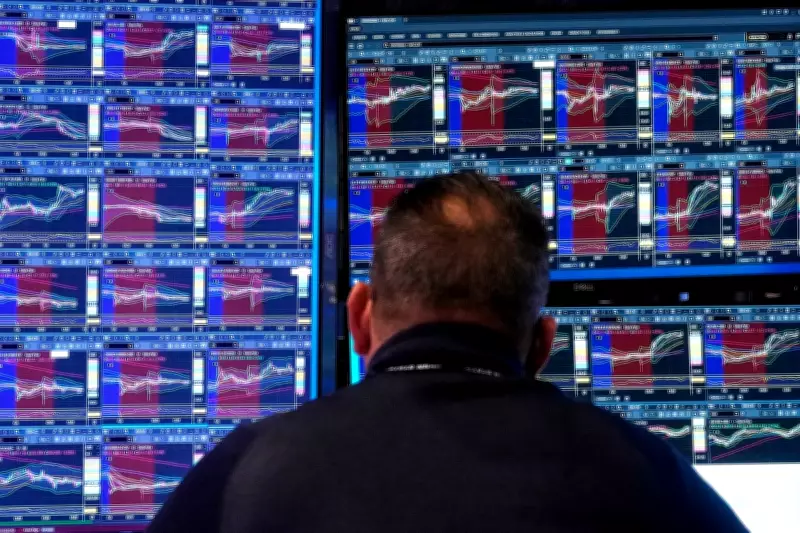
Asian stock markets experienced a broad decline on Thursday, following a retreat on Wall Street that was primarily driven by significant drops in technology stocks. This downward trend reflects ongoing investor concerns about the sector's valuations and future growth prospects, despite some companies reporting strong earnings.
Key Market Movements Across Asia
In Japan, the Nikkei 225 index shed 0.7% to close at 53,935.77. South Korea's Kospi saw a more pronounced decline, skidding 3.2% to 5,199.47. Chinese markets also retreated, with Hong Kong's Hang Seng falling 1.2% to 26,516.38 and the Shanghai Composite index giving up 0.8% to 4,069.27.
Other regional markets followed suit. Australia's S&P/ASX 200 fell 0.3% to 8,902.20, while Taiwan's Taiex lost 1.1%. This widespread weakness came after a mixed session on Wall Street, where the S&P 500 fell 0.5% to 6,882.72 for its fifth modest loss in six days. The Dow Jones Industrial Average managed a 0.5% gain to 49,501.30, but the technology-heavy Nasdaq composite sank 1.5% to 22,904.58.

Technology Sector Under Pressure
The technology sector's struggles were a key theme. More than twice as many stocks rose than fell within the S&P 500, but sinking tech stocks weighed heavily on the index for a second consecutive day. This pressure persists even when companies deliver stronger-than-expected profits, as their stock prices have shot higher in recent years, leading to concerns about overvaluation.
Advanced Micro Devices exemplified this trend, dropping 17.3% despite reporting a quarterly profit that exceeded analysts' expectations and providing a revenue forecast for early 2026 that also topped expectations. The sharp decline suggests investors may be taking profits after the stock doubled over the past 12 months.
Meanwhile, companies like software makers are grappling with questions about potential future competition from artificial-intelligence-powered rivals. Uber Technologies also dragged on the market, falling 5.1% after its latest quarterly results and profit forecast fell short of analysts' expectations.
Notable Exceptions and Commodity Movements
Despite the overall tech weakness, some stocks bucked the trend. Super Micro Computer, which sells AI servers and equipment, surged 13.8% after delivering a stronger quarterly profit than expected. Eli Lilly rallied 10.3% after topping profit expectations, buoyed by strong growth from its Mounjaro and Zepbound products for diabetes and weight loss. Match Group climbed 5.9% on better-than-expected results and an increased dividend.
In a significant milestone, Walmart edged up 0.2%, a day after its total market value surpassed $1 trillion for the first time, joining an elite club dominated by Big Tech giants like Nvidia and Apple.
In commodity markets, gold and silver prices rose after paring earlier, larger gains. Gold added 0.3% to settle at $4,950.80 per ounce, having earlier climbed back above the $5,000 mark. Silver's price rose 1.3%. Both metals have experienced volatile swings recently, with gold nearly reaching $5,600 last week before falling below $4,500 on Monday. Their prices had surged as investors sought safer havens amid concerns about tariffs, a weaker U.S. dollar, and heavy government debt loads worldwide, though critics argue the rally was overextended.
Economic Data and Currency Movements
Treasury yields held relatively steady following mixed U.S. economic reports. ADP Research indicated that U.S. employers outside the government hired fewer workers last month than economists expected. However, the Institute for Supply Management reported that growth for U.S. services businesses continued in January at the expected pace, though it noted that prices paid by these businesses rose at a faster rate, a potentially discouraging signal for inflation.
In early Thursday dealings, U.S. benchmark crude oil fell $1.19 to $63.95 per barrel, while Brent crude, the international standard, lost $1.24 to $68.22 per barrel. The dollar rose slightly to 156.83 Japanese yen from 156.80 yen, and the euro fell to $1.1795 from $1.1804.