

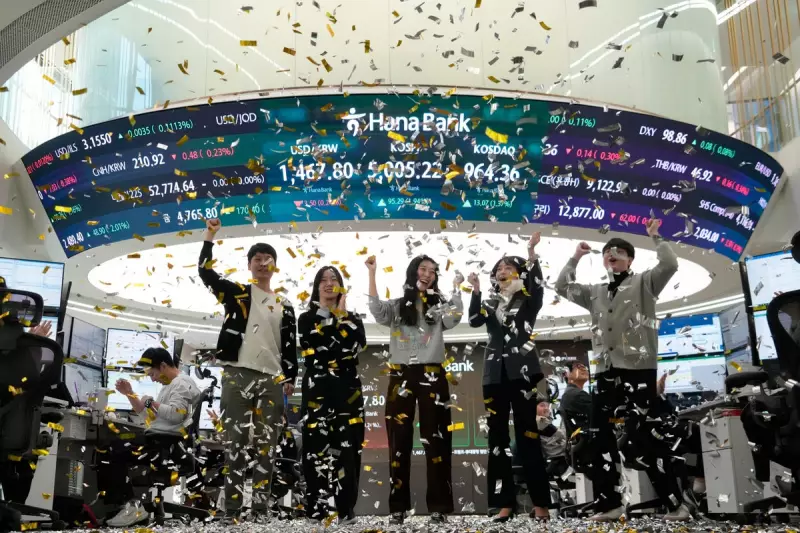
Asian share markets have posted substantial gains, closely mirroring a robust rally on Wall Street, following a significant de-escalation in geopolitical tensions. The shift occurred after U.S. President Donald Trump walked back from imposing tariffs on eight European countries and explicitly ruled out using military force to acquire Greenland.
Market Performance Across Asia
The positive sentiment from the United States fuelled a broad advance across major Asian indices on Thursday. Investor confidence was buoyed by the reduced threat of a trade dispute between the U.S. and its European allies.
Notable Gains in Key Markets
Japan's Nikkei 225 index climbed impressively by 1.9% to close at 53,760.85 points. The rally was led by technology stocks, with SoftBank Group surging 11% and chipmaker Tokyo Electron rising 3.7%.

South Korea's Kospi index increased by 2%, reaching 5,008.08 and crossing the psychologically significant 5,000 mark for the first time. This milestone follows record highs achieved earlier in the month. Technology-related stocks were again the primary drivers, with Samsung Electronics shares up 3.3% and SK Hynix gaining 2.3%.
In Australia, the S&P/ASX 200 traded 0.7% higher, settling at 8,841.70. Taiwan's Taiex jumped 2%, and India's Sensex rose by a solid 0.7%.
Mixed Results in Greater China
Performance was more subdued in Greater China. Hong Kong's Hang Seng index fell slightly by 0.2% to 26,531.29. Similarly, the Shanghai Composite index dropped nearly 0.2%, closing at 4,110.86.
Wall Street's Rally and the Greenland Reversal
The catalyst for the global market optimism was a clear reversal in U.S. policy. Earlier in the week, markets had experienced their most significant losses since October. This sell-off was triggered by President Trump's threat over the weekend to impose 10% tariffs on Denmark, Norway, Sweden, Germany, France, the United Kingdom, the Netherlands, and Finland. The proposed tariffs were a response to these nations opposing U.S. control of Greenland, sparking fears of a worsening transatlantic relationship.
However, attending the World Economic Forum in Davos, Switzerland, President Trump backed down on Wednesday. He stated he would not use force to acquire Greenland and announced via his social media platform that he had agreed with the NATO head on a "framework of a future deal" concerning Greenland and Arctic security.
U.S. Market Response
The easing of tensions propelled a strong recovery on Wall Street. On Wednesday, the S&P 500 climbed 1.2% to 6,875. The Dow Jones Industrial Average gained an identical 1.2%, closing at 49,077.23, while the Nasdaq composite also rose 1.2% to 23,224.82.
Corporate earnings also influenced specific stocks. Halliburton, the oil field services company, jumped 4.1% after reporting stronger-than-expected quarterly profits. United Airlines rose 2.2% following better-than-expected results. In contrast, Netflix fell 2.2% despite a strong profit report, as investors focused on concerns like slowing subscriber growth.
Commodities, Bonds, and Currency Movements
The reduced geopolitical risk had a pronounced effect on other asset classes. The price of gold, a traditional safe-haven asset, fell 0.9% to $4,794.70 per ounce. This decline reflected investors' reduced worries, coming after the metal had surpassed the $4,800 mark on Wednesday ahead of Trump's policy reversal.
In the bond market, U.S. Treasury yields eased as investor fear subsided. The yield on the benchmark 10-year Treasury note fell to 4.25% from 4.30% late Tuesday. This calming effect extended to Japan's bond market, where turmoil had erupted earlier. Long-term yields there had surged to records after Prime Minister Sanae Takaichi's decision to call a snap February election, raising concerns over her tax-cut and spending pledges potentially increasing government debt.
In early Thursday dealings, U.S. benchmark crude oil gained 0.3% to $60.79 per barrel. The international standard, Brent crude, rose 0.2% to $65.35 per barrel.
Currency markets saw the U.S. dollar strengthen slightly against the Japanese yen, rising to 158.54 yen from 158.27. The euro remained mostly unchanged at $1.1693.

The futures market indicated a positive open for U.S. indices, with the S&P 500 future up 0.4% and the Dow Jones Industrial Average future increasing 0.3%.





