

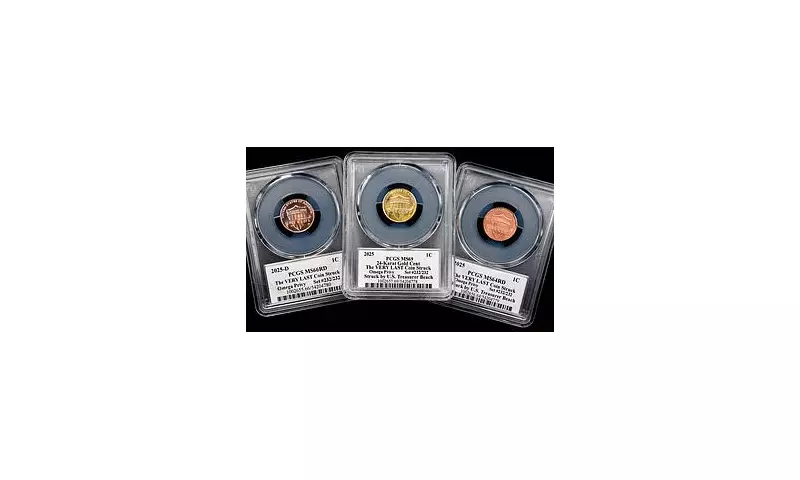
The very last pennies produced for circulation in the United States have been sold at a landmark auction, fetching a staggering total of $16,744,500. Collectors from around the world competed fiercely for the historic coins, which mark the end of 232 years of continuous production.
A Historic Auction for the Final Cents
On December 12, Stack's Bowers Galleries in California auctioned 232 special three-coin sets. Each set contained the final pennies struck at the US Mint, ceremonially produced on November 12 by United States Treasurer Brandon Beach and Acting Mint Director Kristie McNally. The average price per set was an impressive $72,000, with the lowest lot selling for $48,000.
The most expensive single lot achieved a remarkable $800,000. This premium price was for the set deemed the 'very last' cents struck, which also included the three sets of cancelled dies—the tools used to press the design onto the blank coins. Each coin in the historic series was embossed with the Greek letter Omega (Ω), symbolising the end of the production run.

A unique highlight was the inclusion of a first-of-its-kind 99.9 percent 24 karat gold 2025 penny, struck at the Philadelphia Mint. The auction's success made it the highest-value sale of special coins ever conducted on behalf of the United States Mint. Due to unprecedented collector interest, the event was delayed from its original date of December 11.
Celebrating an End of an Era
Acting Mint Director Kristie McNally stated the Mint was excited to share this opportunity with the public. 'The penny has withstood 232 years of our nation's history,' McNally said in a press release. 'We are proud to offer the chance for the public to celebrate this moment into perpetuity.' Each set sold was accompanied by a serialized Certificate of Authenticity.
Brian Kendrella, President of Stack's Bowers Galleries, noted it was an 'extraordinary honor' to partner with the US Mint. 'They captured the public imagination like few rare coins we've ever handled,' Kendrella said, adding that even his expert staff were thrilled to handle the final pennies before the suspension of circulating production.
The Costly Consequence: A Looming Nickel Problem
The phasing out of the one-cent coin was initiated as a measure to cut public spending. The Treasury had long noted that each penny costs more than two cents to produce, making its continued minting economically inefficient.
However, this cost-saving move has unveiled a significant subsequent issue: the problematic economics of the nickel. Rhett Jeppson, a former chief executive of the US Mint, warned that eliminating the penny will inevitably increase demand for nickels. 'You lose more on a nickel than you do on a penny,' Jeppson told the New York Times.
This presents a serious financial dilemma for the Treasury. Nickels, with a face value of five cents, cost approximately 14 cents each to manufacture, creating a substantial loss per coin. Last year alone, nickel production resulted in an $18 million loss. An increased demand for nickels to replace pennies in daily transactions could quickly outweigh any savings achieved by discontinuing the one-cent coin, exacerbating the Treasury's currency production costs.






