

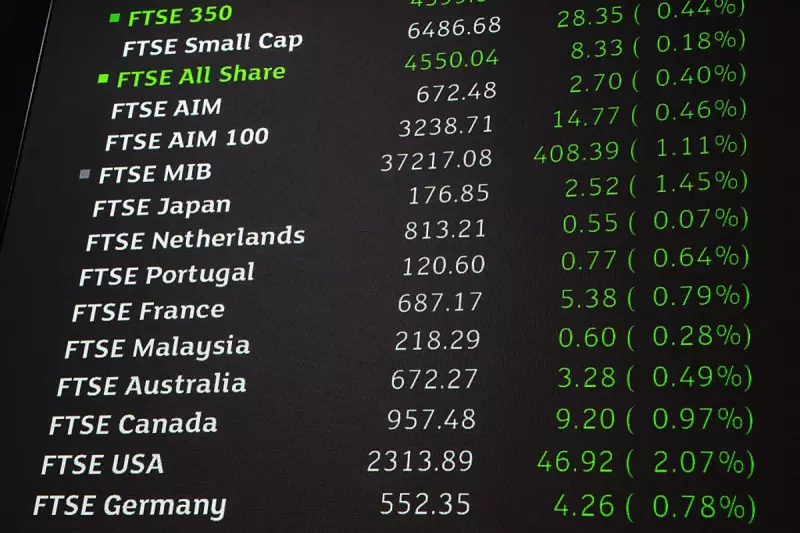
London's premier share index, the FTSE 100, has joined a worldwide bounce in stock markets, rising approximately 0.75 percent in the first hour of trading on Thursday. This upward movement follows a significant geopolitical development, as former US President Donald Trump withdrew his threat of imposing additional tariffs on nations that did not endorse his controversial push to seize control of Greenland.
Global Markets Respond to Reduced Trade Uncertainty
The removal of this tariff threat, which had cast a shadow over international trade relations, sparked an investor rally across much of Asia on Wednesday evening. European indices swiftly followed suit, with Germany's DAX and the Euro Stoxx 50 both gaining around 1.2 percent by 9am GMT. This collective surge marks a notable recovery from earlier in the week, when many major indices experienced declines amid renewed uncertainty over global trade policies.
Asian Indices Lead the Overnight Charge
The positive sentiment originated in Asia, where Japan's Nikkei 225 index rose more than 1.7 percent overnight. South Korea's Kospi also saw a healthy increase of almost 0.9 percent, with smaller yet significant gains recorded in Shanghai, on India's Nifty 50, and on Australia's ASX 200. This broad-based rally underscores how financial markets typically react to a reduction in geopolitical and economic uncertainty, rather than taking a definitive stance on the moral or political outcome of events.

Notable Performers on the London Market
Within the FTSE 100, several companies posted strong early gains. Wealth management firm St. James's Place led the charge, rising 3.1 percent. It was closely followed by property giants Land Securities Group and British Land, which gained 2.8 percent and 2.5 percent respectively, while telecoms heavyweight Vodafone also climbed 2.8 percent. These movements highlight the sectors benefiting from the renewed investor confidence.
Context of Trump's Davos Address and Danish Reaction
The market shift comes in the wake of a lengthy speech delivered by Donald Trump at the World Economic Forum in Davos on Wednesday. His address repeatedly circled back to themes of US security and economic future, with Greenland positioned as a central component of this vision. However, the narrative of a resolved deal has been challenged. A Danish MP has publicly stated that claims of an agreement being struck are "not real," injecting a note of political caution amidst the financial optimism.
Understanding the Market Mechanics of Tariffs
While the direct cost of tariffs is typically borne by American consumers and companies, the US administration has historically framed such measures as demonstrations of economic strength. This is predicated on the volume of exports from other nations to the United States. The market dips witnessed earlier this week, though far less severe than the shocks of April last year when tariffs were first announced, were a direct response to the uncertainty created by the threat. Markets inherently dislike unpredictability; their subsequent rise reflects relief at the threat's withdrawal, even if the underlying trade dynamics remain complex.
Year-to-Date Performance and Outlook
So far this year, the FTSE 100 has demonstrated robust performance, climbing 2.8 percent. In contrast, the US benchmark S&P 500 has seen a more modest gain of 0.4 percent, though it is projected to rise to around 0.6 percent when Wall Street opens later on Thursday. This divergence highlights differing regional economic trajectories and investor sentiments as the global economy navigates a landscape still shaped by the legacy of Trump-era trade policies and ongoing geopolitical manoeuvres.






