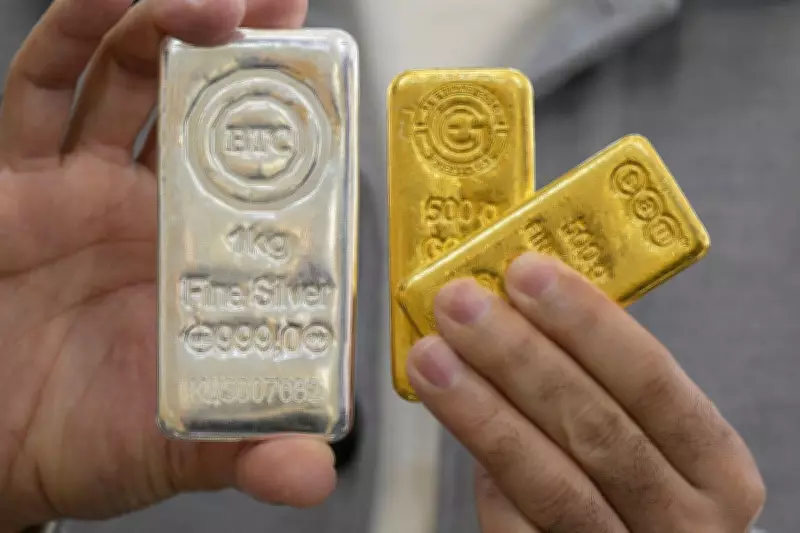
Gold and Silver Prices Experience Sharp Decline
The precious metals market has witnessed a dramatic reversal in fortunes over recent days. After gold spectacularly broke through the $5,000 barrier last week, both it and silver have taken substantial nosedives, leaving investors questioning whether this represents a buying opportunity or a signal to sell.
Recent Price Movements and Current Positions
Gold reached a remarkable peak of over $5,500 at one stage last week, continuing a historic rally that has seen the metal surge more than 80 per cent across the past year. However, by Monday morning, it had plummeted to as low as $4,500 per troy ounce before experiencing a modest recovery. Despite this correction, gold remains up more than 10 per cent over the past month and maintains a substantial 70 per cent annual gain.
The sell-off in silver has been even more pronounced. After an extraordinary rise of well over 150 per cent in price across the past year, silver futures collapsed from $120 on Thursday to below $74 by Monday morning – representing an out-of-hours drop exceeding 30 per cent across the weekend. Remarkably, even after this dramatic decline, silver still shows a 125 per cent increase over just six months.

Understanding the Sudden Market Correction
Several interconnected factors have contributed to this sharp reversal in precious metals prices. The primary driver appears to be profit-taking following the metals' rapid appreciation, with investors seeking to reallocate portions of their portfolios after substantial gains.
Market reactions to Kevin Warsh being selected as the probable new Federal Reserve leader have also influenced sentiment. Additionally, technical factors have played a significant role, with John Wyn-Evans, head of market analysis at Rathbones, explaining: "The sharp pullback in gold looks more like a liquidity and positioning event than a change in the long‑term case for the asset. After a powerful run‑up driven by momentum strategies, short squeezes and leveraged buying, that same positioning has unwound rapidly, amplifying downside moves."
Reports of unsettled trades in specific metals market segments have added to near-term pressure, though analysts emphasise this reflects stress among particular market participants rather than systemic weakness across precious metals.
The Investment Case for Precious Metals
Gold has traditionally served as a safe haven asset, attracting investment during periods of geopolitical uncertainty and market volatility. Unlike government bonds or equities, gold typically exhibits lower volatility over extended periods and can preserve value during economic turbulence.
However, investors should consider several important factors. Gold does not generate income through dividends or interest, meaning it can underperform other assets during periods of price stagnation. Furthermore, its industrial applications are more limited than silver or platinum, with its value primarily derived from its status as a store of wealth.
Financial experts generally recommend allocating no more than 5-10 per cent of a diversified investment portfolio to gold, though individual circumstances including investment timeframe, risk tolerance, and wealth objectives should guide specific decisions.
Practical Approaches to Precious Metals Investment
While purchasing physical gold bullion remains an option, the associated complexities of storage, insurance, and security make this impractical for most investors. A more accessible alternative involves exchange-traded commodities (ETCs), which track gold prices without requiring physical possession.
- The iShares Physical Gold ETC (ticker SGLN on the London Stock Exchange)
- The Royal Mint Responsibly Sourced Physical Gold ETC (ticker RMAU)
Holding these within a stocks and shares ISA provides tax-free gains. Alternative approaches include investing in gold mining companies or broader funds that include precious metals alongside other assets.

Expert Perspectives and Future Outlook
Despite recent volatility, many analysts maintain a positive long-term outlook for precious metals. Lale Akoner, global market analyst for eToro, observes: "Gold is increasingly being used by investors as a hedge against equity risk, and in many portfolios, it is starting to replace long-duration government bonds as the preferred defensive asset."
Market research firm Yardeni projects continued appreciation, stating: "We are still targeting $6,000 by the end of this year and $10,000 by the end of 2029." Several researchers have suggested gold could reach $6,000 per ounce before 2026 concludes, though the timing of such movements remains uncertain.
The fundamental drivers for precious metals investment – geopolitical uncertainty, inflation concerns, and portfolio diversification needs – continue to support their strategic role in investment portfolios, despite recent price corrections.