

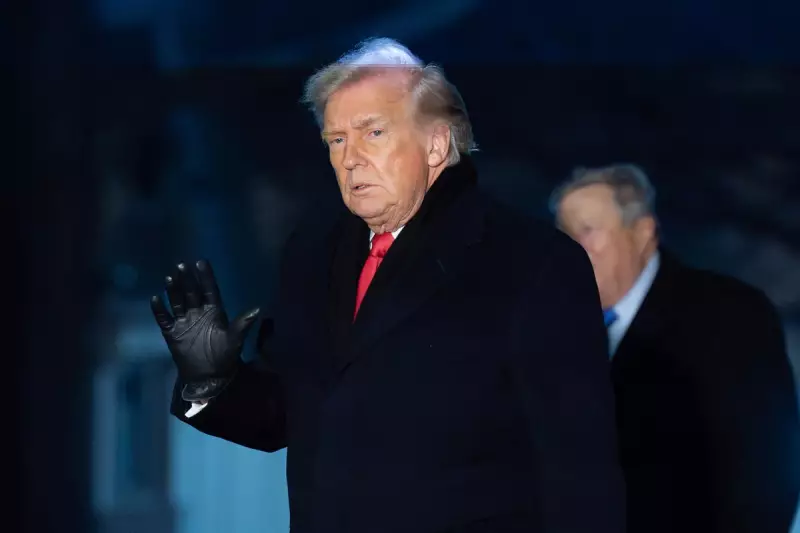
Global financial markets have been thrown into turmoil following a fresh wave of geopolitical threats from former US President Donald Trump, sending major indices across Europe and Asia into a sharp decline.
Market Rout Follows Trump's Provocative Posts
The sell-off began in earnest on Tuesday morning, with London's FTSE 100 Index plunging more than 120 points shortly after the open. This represented a steep drop of 1.3 per cent, bringing the index down to 10068.4, which compounded a 0.4 per cent fall from the previous trading session.
The catalyst was a series of posts on Trump's Truth Social platform overnight, in which he forcefully reiterated his ambition to acquire Greenland, the vast Arctic territory belonging to Denmark, a key NATO ally. He accompanied his statements with a picture of himself holding a US flag on Greenland, suggesting the territory would be owned by the US this year.

Davos in the Spotlight as Tensions Escalate
Trump, who is en route to the World Economic Forum in Davos, Switzerland, had initially sparked the controversy on Saturday. He threatened to impose tariffs of up to 25 per cent on nations, including the UK, that fail to support his plans for Greenland. He has since stated there is "no going back" on his pledge.
Kathleen Brooks, research director at XTB, noted the critical nature of the upcoming forum. "The meeting in Davos later this week will be critical," she said, adding that Trump also claimed he would hold a Greenland meeting there after discussions with NATO Secretary General Mark Rutte.
The anxiety spread across European bourses, with Germany's Dax down 1 per cent and France's Cac 40 off 0.9 per cent in early trading. These losses mirrored sharp overnight declines in Asian markets. US markets, closed on Monday for Martin Luther King Jr Day, were poised for a difficult reopening, with futures trading pointing to steep falls.
Safe Havens Rise as Bonds and Currencies React
In a classic flight to safety, gold prices soared to a new record of $4,728 (£3,507) per ounce during Tuesday morning's trading session.
The turmoil also impacted debt markets. Yields on UK Government bonds, or gilts, edged higher amid a wider sell-off. This was partly triggered by a plunge in Japan's government bonds following news of a snap election to be held there on 8 February.
On currency markets, the pound continued to rise against a weakened US dollar, gaining 0.4 per cent to reach $1.348. However, it lost 0.3 per cent against the euro, trading at €1.15.
Analysts warn that market stability now hinges directly on the former president's actions in the coming days, with all eyes on developments at the high-profile gathering in Davos.






