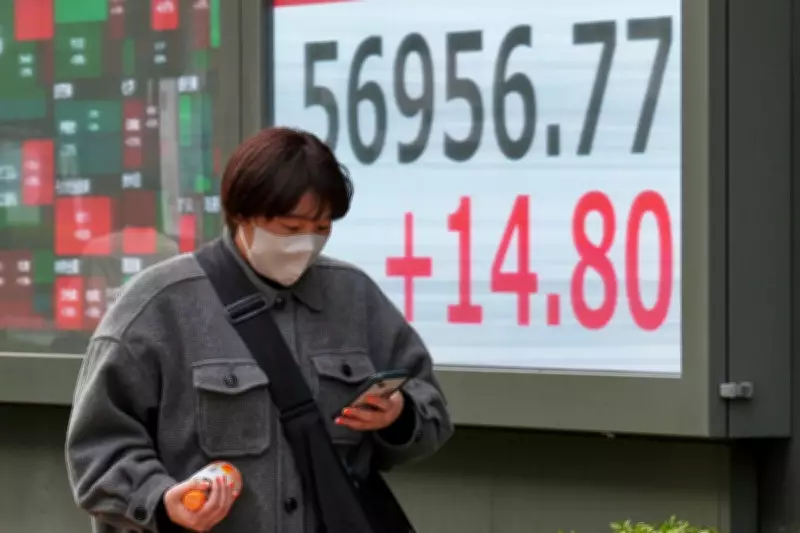
Japan's benchmark Nikkei 225 index fell approximately 1% on Tuesday, reaching 56,237.65 by midday, as traders locked in profits from recent record highs. This decline occurred while most markets across Asia were shuttered for Lunar New Year holidays, creating a subdued trading environment.
Market Movements Across the Region
In contrast to Japan's downturn, Australia's S&P/ASX 200 gained 0.3% to 8,964.10, showcasing regional divergence. India's Sensex edged 0.1% lower, and Thailand's SET dropped less than 0.2%, reflecting mixed performances in the few open markets.
Factors Influencing the Nikkei's Slide
The Nikkei's retreat follows a significant rally after Prime Minister Sanae Takaichi's ruling party secured a resounding victory in the February 8 general election. However, weak economic data released on Monday clouded sentiment in Tokyo, contributing to the decline. Additionally, a sharp 6.2% drop for tech giant SoftBank Group pulled shares lower, exacerbating the market's downward trend.

Polls indicate that Takaichi's popularity is slowly slipping as hopes for economic revival from her plans to increase government spending and cut taxes begin to subside. This political uncertainty has added to investor caution, prompting profit-taking after the recent gains.
Global Market Context and Commodity Shifts
European shares ended mixed on Monday, while U.S. trading was closed for Presidents Day, with markets set to reopen on Tuesday. On Friday, the S&P 500 edged up less than 0.1% after one of its worst losses since Thanksgiving, the Dow Jones Industrial Average rose 0.1%, and the Nasdaq composite slipped 0.2%.
Share prices have been fluctuating with confidence levels over massive investments in artificial intelligence. Investors remain focused on inflation and how price pressures might affect interest rates, adding to market volatility.
Commodity and Currency Updates
In early Tuesday dealings, benchmark U.S. crude rose 65 cents to $63.54 a barrel, while Brent crude, the international standard, lost 29 cents to $68.36 a barrel. The U.S. dollar slipped to 153.17 Japanese yen from 153.51 yen, and the euro decreased to $1.1841 from $1.1852.
Precious metals also saw declines, with gold falling 1.4% and silver down 3.4%. Bitcoin dropped 0.6% to approximately $68,500, reflecting broader market uncertainties.
This market activity underscores the interconnected nature of global finance, where regional holidays, political developments, and economic data collectively shape trading outcomes.