

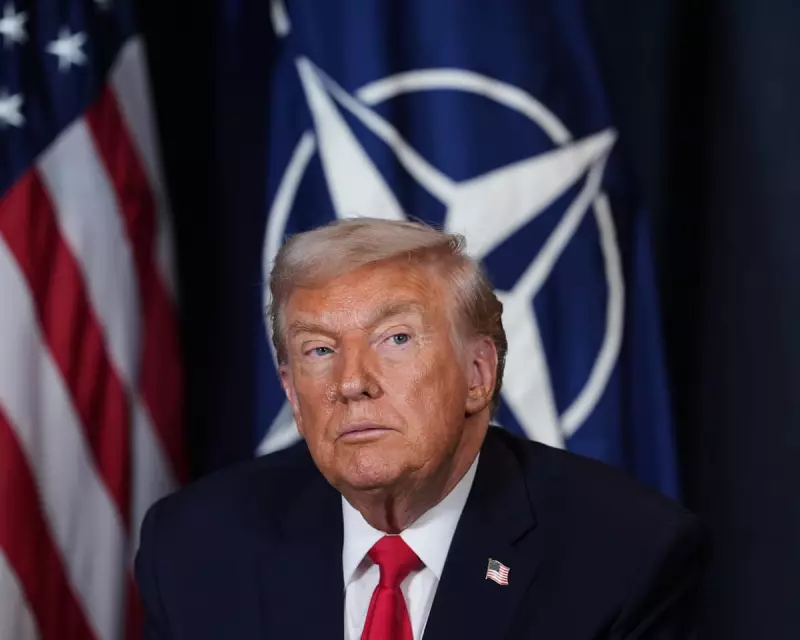
European financial markets experienced a significant upswing on Thursday, buoyed by the unexpected cancellation of impending tariffs by former US President Donald Trump. The decision prompted a wave of investor optimism, with analysts quickly labelling the market movement as the return of the "Trump Always Chickens Out" or "Taco" trade phenomenon.
Market Reaction to Tariff Reprieve
The FTSE 100 index in London climbed 0.8%, reaching a peak of 10,225 points during the trading session. Across the Channel, Germany's Dax and France's Cac 40 indices both posted robust gains of 1.4%. The broader pan-European Stoxx 600 index mirrored this performance, also rising by 1.4%. Forecasts indicated that Wall Street was poised to open higher later in the day, extending the positive sentiment.
This rally marked the first positive movement for European equities this week, following a period of uncertainty and decline. The upswing came directly in response to Trump's reversal on previously announced plans to impose fresh tariffs on a coalition of eight European nations: Germany, France, the United Kingdom, Denmark, Sweden, the Netherlands, Norway, and Finland. These tariffs were slated to commence on 1 February.

The 'Taco' Trade Returns
Market commentators were swift to identify the pattern. Richard Hunter, Head of Markets at Interactive Investor, stated it represented "the return of the Taco trade." This refers to a historical market pattern where threats of aggressive trade action from the Trump administration were frequently walked back, leading to relief rallies.
Neil Wilson, a strategist at Saxo Bank, elaborated on the market's perspective, noting: "From the market point of view, it's the classic Taco trade. The pivot has left markets buoyant as the very real threat of a trade war has receded."
Context of the Withdrawn Threats
The tariff announcement had been intrinsically linked to broader geopolitical manoeuvring. Trump had initially connected the proposed tariffs to an agreement for the United States to purchase Greenland, a plan that has surfaced periodically. The president formally withdrew the threat of using military force to acquire the territory during a speech at the World Economic Forum in Davos, Switzerland, on Wednesday.
Later that same day, Trump took to his social media platform to announce he would not impose the tariffs. He cited reaching an unspecified "framework deal" with NATO Secretary General Mark Rutte as the reason for the reversal.
Broader Financial Implications
The relief was felt across multiple asset classes. Jim Reid, Head of Macro and Thematic Research at Deutsche Bank, described the moves as a "big relief rally as investors priced out escalatory scenarios, with financial stress easing across multiple asset classes." Global stock markets had fallen heavily at the start of the week, with US share prices only beginning to rebound on Wednesday afternoon in New York.
However, Reid noted a note of caution, pointing out that key US benchmarks like the S&P 500 and the US dollar remained weaker than their positions the previous Friday, suggesting underlying concerns persist.
Currency and Haven Assets
In currency markets, the US dollar showed little movement against major European currencies during Thursday morning trading in London. The exchange rates held steady with one euro buying $1.1689 and one pound sterling buying $1.3427.
Meanwhile, gold prices, which often act as a safe-haven asset during periods of geopolitical or economic uncertainty, remained flat. Spot gold traded at $4,833 per troy ounce, maintaining levels near record highs as some investors continue to question the long-term appeal of US assets.
Analyst Outlook and Caveats
Lee Hardman, a Senior Currency Analyst at MUFG Bank, provided a measured assessment: "Market participants have expressed initial relief that the threat of US military action or tariffs is off the table at least for now, although will remain wary that they could return if talks don't progress as President Trump desires in the coming weeks and months."
He added a positive note for global economic prospects, stating: "Avoiding a tit-for-tat trade war is a positive development for the global growth outlook and supports our outlook for stronger growth this year."

The market's positive reaction underscores the sensitivity of global finance to trade policy statements and the lasting impact of the "Taco" trade narrative, where bold threats are often followed by tactical retreats, triggering swift market corrections.





