

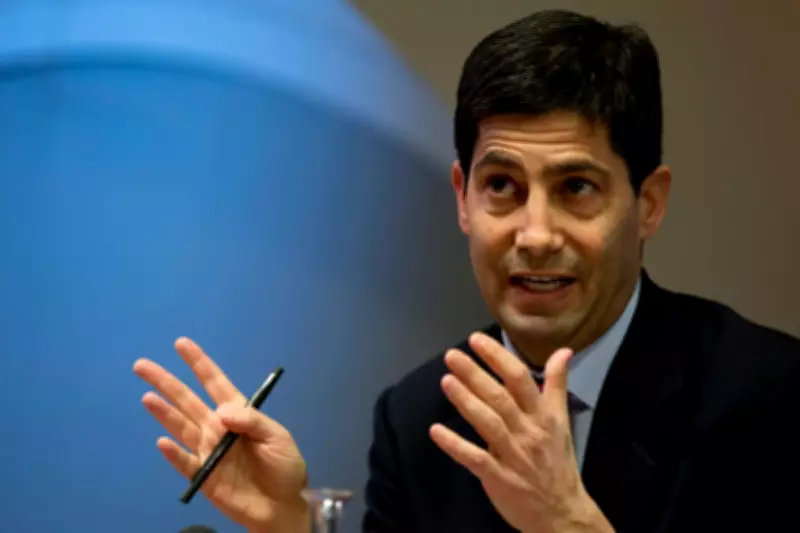
Trump Nominates Kevin Warsh for Federal Reserve Chairmanship
In a significant move that could reshape monetary policy in the United States, former President Donald Trump has announced his nomination of Kevin Warsh to serve as the next chairman of the Federal Reserve. This decision, revealed on Friday, 30th January 2026, targets the replacement of the current chair, Jerome Powell, whose term is set to conclude in May.
Market Reactions and Investor Sentiment
Financial markets responded promptly to the news, with the US dollar strengthening and European stock indices trending upwards during Friday's trading session. Analysts and portfolio managers have interpreted Warsh's selection as a potentially stabilising force for investors who have grown increasingly concerned about volatility and political pressures on the Fed.
Stuart Clark, a portfolio manager at Quilter, remarked, "Concerns around Fed independence and an erosion on this should now be tempered, although Warsh’s words and actions will be scrutinised by market participants intensely." He added that the appointment is likely to calm markets, which had recently exhibited more erratic behaviour.

Kevin Warsh's Background and Policy Stance
Kevin Warsh is no stranger to the Federal Reserve, having served as a governor from 2006 to 2011, a period that included the tumultuous 2008 financial crisis. His tenure earned him a reputation as a competent crisis manager with a deep understanding of financial markets. Historically viewed as a hawkish economist, Warsh has typically advocated for higher interest rates to combat inflation, aligning with more conservative monetary approaches.
However, his recent public statements have indicated a shift towards supporting lower interest rates, a nuance that traders and economists are closely monitoring. Luke Bartholomew, deputy chief economist at Aberdeen Investments, noted, "As chair, he will almost certainly push for lower interest rates, consistent with our forecast of two 25 basis point cuts later this year."
The Context of Fed Independence and Political Pressure
This nomination arrives during a particularly fraught period for the Federal Reserve and its current leadership. Earlier in January, Jerome Powell released a video statement alleging threats from a criminal investigation initiated under the Trump administration, related to his testimony on renovation projects at Fed offices. Powell asserted that these threats stemmed from the Fed's commitment to setting interest rates based on economic assessments rather than political preferences.
The situation prompted expressions of solidarity from central bank leaders worldwide, including the Bank of England's Andrew Bailey, who emphasised the importance of preserving the institution's independence. The Federal Reserve, like its global counterparts, is designed to operate autonomously from government influence, granting its chair considerable power over the world's largest economy.
Expert Analysis and Future Outlook
Dan Coatsworth, head of markets at AJ Bell, observed, "Investors seem to be taking this as a positive sign in terms of Fed independence – with Warsh perceived as a more orthodox choice versus some of the other mooted names." He highlighted Warsh's previous candidacy against Powell in 2017 and the ongoing question of whether external pressures might influence his policy stance.
Currency markets reflected the day's developments, with the pound declining by approximately 0.4% against the US dollar, and the euro similarly weakening by 0.4% in afternoon trading. As the nomination proceeds to the US Senate for approval, market participants remain vigilant, aware that the Trump presidency often brings unpredictability. The broader implications for monetary policy, inflation control, and global economic stability will unfold in the coming months, with Warsh's potential leadership poised at the centre of these critical discussions.






