

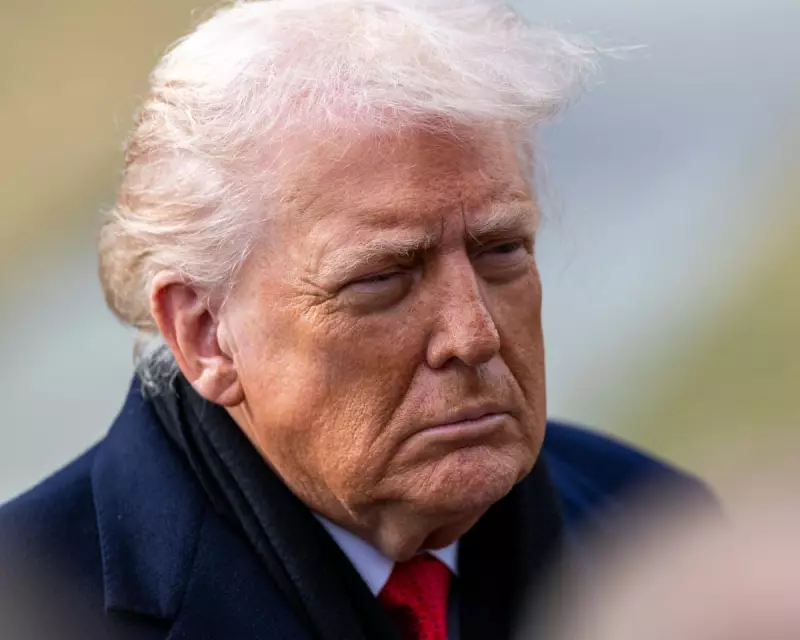
Financial experts are sounding the alarm that the Reserve Bank of Australia could see its independent rate-setting authority undermined if former President Donald Trump succeeds in his unprecedented bid to assert control over the United States Federal Reserve. The potential geopolitical shift carries severe global consequences, with Australia facing the prospect of forced interest rate reductions to combat a dramatically stronger domestic currency.
Legal Battle Threatens Fed Independence
The immediate trigger for concern stems from a critical legal case before the US Supreme Court, scheduled for arguments this Wednesday. The proceedings will determine whether the American president possesses the authority to dismiss Lisa Cook, a sitting member of the Federal Reserve's board of governors. This follows closely on the heels of a Department of Justice criminal investigation announced just ten days prior, targeting current Fed Chair Jerome Powell.
Sally Auld, chief economist at National Australia Bank, articulated the stakes clearly. "If the court upholds Trump's efforts to sack Cook, that could spell the beginning of the end of the central bank's independence," she warned. The ramifications of Washington politicians wresting control of monetary policy would be profound, likely triggering a crisis of confidence in the US dollar and American financial assets like stocks and bonds.

Domino Effect on Australian Monetary Policy
In a worst-case scenario, the resulting plunge in the US dollar's value could be substantial. "The magnitude of the depreciation of the US dollar would be quite significant," Auld projected. For Australia, the direct impact would be a sharply appreciating Australian dollar, potentially jumping by as much as fifteen percent.
Such currency strength would make Australian exports less competitive and could itself create sufficient economic pressure to demand a policy response from the RBA. "Their hand could be forced," Auld stated, indicating the central bank might have little choice but to implement interest rate cuts to weaken the Aussie dollar, even if domestic inflation concerns persist.
Inflation Risks and Political Precedents
Shane Oliver, chief economist at AMP, echoed these concerns, outlining how a politically subservient Fed might keep rates artificially low for too long, leading to an "inflation blowout." This would further hammer the US dollar and likely depress Wall Street markets. The flow-on effect to Australia could paradoxically mean lower interest rates alongside a stronger currency—a combination some might initially welcome, but which carries the latent risk of importing more inflation.
Oliver stressed that achieving complete control would require Trump to install loyalists in at least four of the seven governor positions on the Fed's board, a scenario he views as unlikely but not impossible. Regardless of the immediate outcome, he warned that Trump's assault on central bank independence sets a dangerous precedent for populists worldwide. "For Australia, the problem is that this is the world's most significant central bank. If the threats to independence are happening there, then it would happen here," Oliver cautioned.
Vulnerabilities in Australia's Institutional Framework
The analysis reveals that Australia's own safeguards may already be weaker than those in the United States. "To get a governor appointed in the US you have to go through a committee, whereas here you are just appointed by the Treasurer," Oliver noted, highlighting a key structural vulnerability.
Political pressure on the RBA's independence is not a hypothetical future threat; it is already manifesting. The Greens' economic spokesperson, Nick McKim, last year publicly urged Treasurer Jim Chalmers to "show some courage" and use legislative powers to directly override the RBA and force rate cuts. Meanwhile, populist figures on the right, such as Liberal MPs Andrew Hastie and Senator Jacinta Nampijinpa Price, might be emboldened to follow Trump's lead, particularly if the RBA raises rates this year.

Diverging Paths and Guarded Optimism
Despite the ominous warnings, some economists maintain a degree of optimism about the RBA's capacity to chart its own course. Luci Ellis, Westpac's chief economist and a former senior RBA official, argued that Australia should still be able to pursue an independent monetary policy even if the Fed's independence is compromised.
"There's no particular reason we have to follow what the Fed does," Ellis asserted, pointing to recent history where Australian and American monetary policy paths have clearly diverged. "It would be bad if the biggest and most powerful central bank lost some of its operational independence, but it would not in and of itself change how the RBA would need to behave."
For now, financial markets remain surprisingly calm in the face of these unprecedented political attacks on the Fed's autonomy. Sally Auld observed that this tranquillity "feels a little bit out of sync with the way people are sensing the world at the beginning of 2026." The Fed's next interest rate decision, due on 29 January Australian time, will be the first made under the shadow of the criminal investigation into Chair Powell, serving as an early test of the institution's resilience.





