

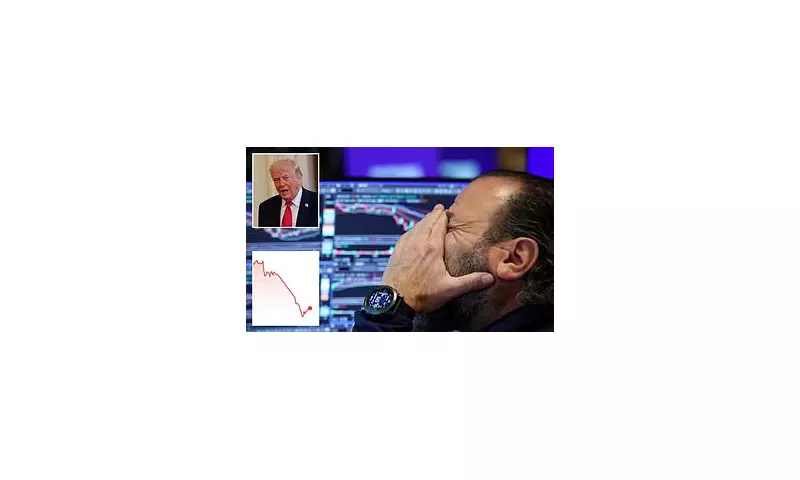
Financial markets across the globe were plunged into turmoil on Tuesday as former President Donald Trump's renewed and aggressive campaign to acquire Greenland sent shockwaves through trading floors. With Wall Street having been closed for the holiday since Trump's initial threat on Saturday, the full impact was poised to hit when US exchanges reopened, with futures contracts painting a stark picture of impending losses.
Futures Signal Sharp Sell-Off Ahead of New York Opening
Trading in futures provided an early and alarming indicator of investor sentiment, suggesting heavy losses were imminent when stock markets commenced trading at 9:30 AM in New York. Analysts warned that the situation had the potential to erase billions from the value of US equities and severely impact American investment portfolios, including widely held 401(K) retirement accounts.
Key Market Indicators Point to Significant Declines
The Dow Jones Industrial Average futures pointed to precipitous losses of approximately 680 points, while S&P 500 futures were down by about 1.4 percent. Technology stocks appeared particularly vulnerable, with Nasdaq futures declining by roughly 1.7 percent. This downward trajectory suggested the S&P 500 was facing its most challenging trading session in two months.

Jim Reid, a prominent strategist at Deutsche Bank, noted the delayed market reaction, stating, 'With the US off yesterday, the tariff threat hadn’t fully hit markets. There’s room for bigger moves.' This sentiment was echoed by a surge in Wall Street's so-called 'fear gauge', with the VIX volatility index jumping a substantial 27 percent to breach the 20 level for the first time since November.
Trump's Tariff Threats Escalate Trade Tensions
The market anxiety was compounded by Trump's explicit tariff threats targeting eight European NATO countries that have opposed the Greenland acquisition proposal. He declared that imports from these nations would face tariffs starting at 10 percent from February 1, escalating to 25 percent by June 1, with these measures to remain in place until a deal on Greenland is finalised.
European Markets and Currency Reactions
European equity markets, which opened earlier, experienced notable share price declines as the news reverberated across the continent. Concurrently, traders initiated a significant 'Sell America' trade, offloading US dollars and government bonds. The dollar index, which measures the currency's strength against six major counterparts, dropped by 0.9 percent.
Furthermore, the benchmark 10-year Treasury yield rose to around 4.29 percent, moving higher as investors rapidly divested from government debt. In a subsequent escalation, Trump threatened imposing 200 percent tariffs on French wine and champagne and criticised the United Kingdom regarding the Chagos Islands dispute.
International Pushback and Diplomatic Fallout
European leaders swiftly pushed back against these aggressive trade measures. France, in particular, urged the European Union to consider deploying its most formidable countermeasure—the Anti-Coercion Instrument, often referred to as the 'trade bazooka'. This development sets the stage for heightened diplomatic tensions as Trump prepares to address the World Economic Forum in Davos on Wednesday.
The confluence of geopolitical manoeuvring and punitive economic policies has created a perfect storm of uncertainty, leaving investors and policymakers alike bracing for further volatility and potential escalation in the coming days.






