

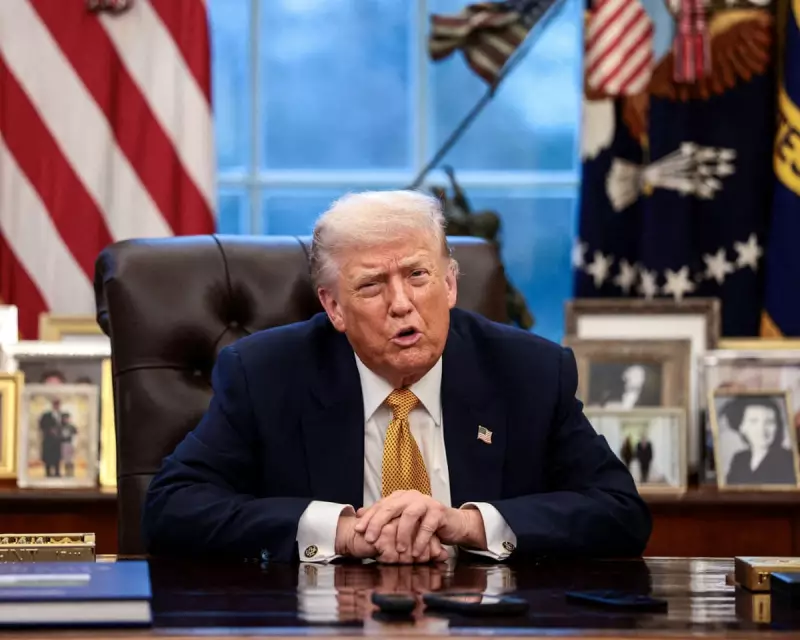
Global financial markets have been thrown into turmoil at the start of the week following a renewed threat of tariffs from former US President Donald Trump, directly linked to his longstanding ambition to acquire Greenland.
Market Reaction and Immediate Fallout
Investors across Europe were spooked by the announcement, leading to a sharp pre-market sell-off. Futures for the pan-European Stoxx 50 index dropped 1.51%, indicating a rocky open. The UK's benchmark FTSE 100 was down 0.48%, while France's Cac 40 was poised for a steeper 2.1% fall and Germany's Dax pointed to a 1.35% decline.
The threat involves imposing new trade levies of 10% on goods from eight European countries – Denmark, Norway, Sweden, France, Germany, the UK, the Netherlands, and Finland – starting 1 February, with plans to raise them to 25% on 1 June.

In Asia, trading was more mixed. Japan's Nikkei 225 slipped 0.7%, while investors assessed Chinese economic data. Commodity markets also reacted: Brent crude oil fell 0.73% to $63.66 a barrel, and West Texas Intermediate dropped 0.61% to $59.08. The US Dollar index weakened by 0.23%.
In a classic flight to safety, gold surged to a fresh high of $4,689.39 per ounce, trading up around 1.6%. Spot silver also jumped approximately 3.8% to $93.39 per ounce after hitting a record peak.
Diplomatic Chess and Potential Retaliation
The move has triggered urgent diplomatic manoeuvres across the Atlantic. An emergency summit of EU leaders is reportedly scheduled for this week, likely on Thursday, to formulate a coordinated response.
European officials are actively exploring countermeasures. One option is activating the EU's Anti-Coercion Instrument (ACI), which came into force at the end of 2023, though its formal process could take months. More immediately, EU ambassadors have discussed implementing €93 billion in retaliatory tariffs that were prepared in response to Trump's previous tariff rounds but never used.
Jim Reid of Deutsche Bank offered a nuanced perspective, suggesting market pressure could influence the outcome. He noted that past tariff threats have been softened, and highlighted the US's "huge twin deficits" as a potential vulnerability. He also pointed to domestic political headwinds for Trump, citing a recent Reuters/Ipsos poll showing only 17% of US citizens supported efforts to acquire Greenland, with 47% opposed.
UK Chancellor Hails "New Golden Age" for City
Amid the international market turbulence, UK Chancellor Rachel Reeves was in London championing domestic financial reforms. New regulatory rules simplifying IPOs and capital raising came into effect, aiming to boost the City's competitiveness.
Reeves is expected to declare a "new golden age for the City," arguing that London is thriving because it is "open, dynamic and forward-looking." She will state that the UK is making itself "the best place in the world to start, scale and list a company."
The coming days will be critical in determining whether Europe's response can mitigate the economic shock, and whether Trump's tariff strategy, entwined with a geopolitical ambition, will hold firm in the face of market and diplomatic pressure.






